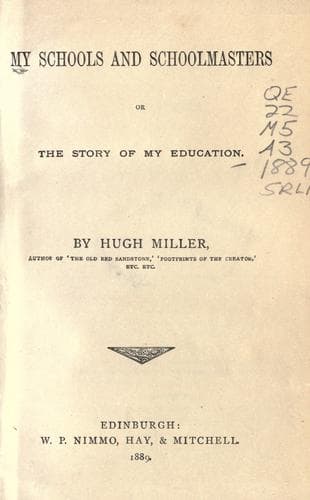
My Schools and Schoolmasters; Or, The Story of My EducationMiller, Hugh
Philosophy
My Schools and Schoolmasters; Or, The Story of My Education
Miller, Hugh
Education -- Scotland -- History -- 19th century; Geologists -- Scotland -- Biography; Miller, Hugh, 1802-1856 -- Knowledge and learning
I was joined in the course of a few weeks, in Peggy Russel's one-roomed
cottage, by another lodger--lodgers of the humbler class usually
consociating together in pairs. My new companion had lived for some
time, ere my arrival at Niddry, in a neighbouring domicile, which, as he
was what was termed a "quiet-living man," and as the inmates were
turbulent and unsteady, he had, after bearing a good deal, been
compelled to quit. Like our foreman, he was a strict Seceder, in full
communion with his Church. Though merely a common labourer, with not
more than half the wages of our skilled workmen, I had observed, ere our
acquaintance began, that no mason in the squad was more comfortably
attired on week-days than he, or wore a better suit on Sunday; and so I
had set him down, from the circumstance, as a decent man. I now found
that, like my uncle Sandy, he was a great reader of good books--an
admirer even of the same old authors--deeply read like him, in Durham
and Rutherford--and entertaining, too, a high respect for Baxter,
Boston, old John Brown, and the Erskines. In one respect, however, he
differed from both my uncles: he had begun to question the excellence of
religious Establishments; nay, to hold that the country might be none
the worse were its ecclesiastical endowments taken away--a view which
our foreman also entertained; whereas both Uncles Sandy and James were
as little averse as the old divines themselves to a State-paid ministry,
and desiderated only that it should be a good one. There were two other
Seceders engaged as masons at the work--more of the polemical and less
of the devout type than the foreman or my new comrade the labourer; and
they also used occasionally to speak, not merely of the doubtful
usefulness, but--as they were stronger in their language than their more
self-denying and more consistent co-religionists--of the positive
worthlessness of Establishments. The Voluntary controversy did not break
out until about nine years after this time, when the Reform Bill gave
vent to many a pent-up opinion and humour among that class to which it
extended the franchise; but the materials of the war were evidently
already accumulating among the intelligent Dissenters of Scotland; and
from what I now saw, its first appearance in a somewhat formidable
aspect failed to take me by surprise. I must in justice add, that all
the religion of our party was to be found among its Seceders. Our other
workmen were really wild fellows, most of whom never entered a church. A
decided reaction had already commenced within the Establishment, on the
cold, elegant, unpopular Moderatism of the previous period--that
Moderatism which had been so adequately represented in the Scottish
capital by the theology of Blair and the ecclesiastical policy of
Robertson; but it was chiefly among the middle and upper classes that
the reaction had begun; and scarce any portion of the humbler people,
lost to the Church during the course of the two preceding generations,
Public-domain text, read in full here on John Shaqi.
Reviews
Reviews
No reviews yet
Be the first to share your thoughts on this work.
Elsewhere in the archive
Join the Discussion
Join the discussion
Sign in to leave a comment or review.
Sign InorCreate an account