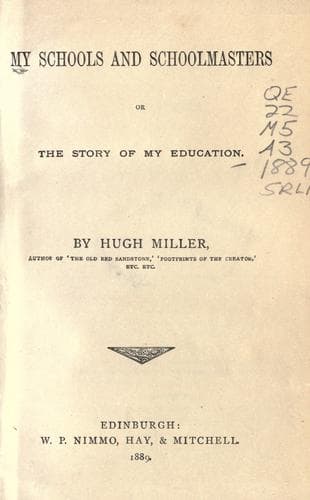
My Schools and Schoolmasters; Or, The Story of My EducationMiller, Hugh
Philosophy
My Schools and Schoolmasters; Or, The Story of My Education
Miller, Hugh
Education -- Scotland -- History -- 19th century; Geologists -- Scotland -- Biography; Miller, Hugh, 1802-1856 -- Knowledge and learning
There was of course a considerable diversity of talent and acquirement
among my more reckless associates at the work; and it was curious enough
to mark their very various views regarding what constituted spirit or
the want of it. One weak lad used to tell us about a singularly spirited
brother apprentice of his, who not only drank, kept loose company, and
played all sorts of very mischievous practical jokes, but even
occasionally stole, out of warehouses; which was of course a very
dauntless thing, seeing that it brought him within wind of the gallows;
whereas another of our wild workmen--a man of sense and
intelligence--not unfrequently cut short the narratives of the weaker
brother, by characterizing his spirited apprentice as a mean, graceless
scamp, who, had he got his deservings, would have been hung like a dog.
I found that the intelligence which results from a fair school
education, sharpened by a subsequent taste for reading, very much
heightened in certain items the standard by which my comrades regulated
their conduct. Mere intelligence formed no guard amongst them against
intemperance or licentiousness; but it did form a not ineffectual
protection against what are peculiarly the mean vices--such as theft,
and the grosser and more creeping forms of untruthfulness and
dishonesty. Of course, exceptional cases occur in all grades of society:
there have been accomplished ladies of wealth and rank who have indulged
in a propensity for stealing out of drapers' shops; and gentlemen of
birth and education who could not be trusted in a library or a
bookseller's back-room; and what sometimes occurs in the higher walks
must be occasionally exemplified in the lower also; but, judging from
what I have seen, I must hold it as a general rule, that a good
intellectual education is a not inefficient protection against the
meaner felonies, though not in any degree against the "pleasant vices."
The only adequate protection against both, equally, is the sort of
education which my friend John Wilson the labourer exemplified--a kind
of education not often acquired in schools, and not much more frequently
possessed by schoolmasters than by any other class of professional men.
Public-domain text, read in full here on John Shaqi.
Reviews
Reviews
No reviews yet
Be the first to share your thoughts on this work.
Elsewhere in the archive
Join the Discussion
Join the discussion
Sign in to leave a comment or review.
Sign InorCreate an account