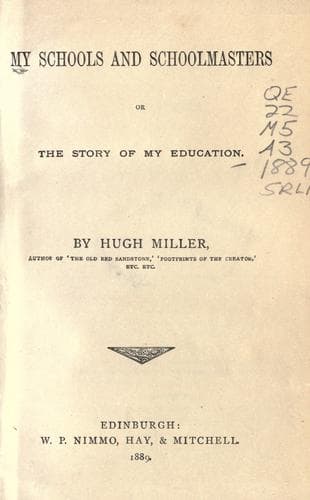
My Schools and Schoolmasters; Or, The Story of My EducationMiller, Hugh
Philosophy
My Schools and Schoolmasters; Or, The Story of My Education
Miller, Hugh
Education -- Scotland -- History -- 19th century; Geologists -- Scotland -- Biography; Miller, Hugh, 1802-1856 -- Knowledge and learning
I sometimes heard old Dr. Colquhoun of Leith preach. There were fewer
authors among the clergy in those days than now; and I felt a special
interest in a living divine who had written so good a book, that my
uncle Sandy--no mean judge in such matters--had assigned to it a place
in his little theological library, among the writings of the great
divines of other ages. The old man's preaching days, ere the winter of
1824, were well-nigh done: he could scarce make himself heard over half
the area of his large, hulking chapel, which was, however, always less
than half filled; but, though the feeble tones teasingly strained the
ear, I liked to listen to his quaintly attired but usually very solid
theology, and found, as I thought, more matter in his discourses than in
those of men who spoke louder and in a flashier style. The worthy man,
however, did me a mischief at this time. There had been a great Musical
Festival held in Edinburgh about three weeks previous to the
conflagration, at which oratorios were performed in the ordinary pagan
style, in which amateurs play at devotion, without even professing to
feel it; and the Doctor, in his first sermon after the great fires, gave
serious expression to the conviction, that they were judgments sent upon
Edinburgh, to avenge the profanity of its Musical Festival. Edinburgh
had sinned, he said, and Edinburgh was now punished; and it was
according to the Divine economy, he added, that judgments administered
exactly after the manner of the infliction which we had just witnessed
should fall upon cities and kingdoms. I liked the reasoning very ill. I
knew only two ways in which God's judgments could be determined to be
really such--either through direct revelation from God himself, or in
those cases in which they take place so much in accordance with His
fixed laws, and in such relation to the offence or crime visited in them
by punishment, that man, simply by the exercise of his rational
faculties, and reasoning from cause to effect, as is his nature, can
determine them for himself. And the great Edinburgh fires had come under
neither category. God did not reveal that He had punished the tradesmen
and mechanics of the High Street for the musical sins of the lawyers and
landowners of Abercromby Place and Charlotte Square; nor could any
natural relation be established between the oratorios in the Parliament
House or the concerts in the Theatre Royal, and the conflagrations
opposite the Cross or at the top of the Tron Church steeple. All that
could be proven in the case were the facts of the festival and of the
fires; and the further fact, that, so far as could be ascertained, there
was no visible connexion between them, and that it was not the people
who had joined in the one that had suffered from the others. And the
Doctor's argument seemed to be the perilous loose one, that as God had
sometimes of old visited cities and nations with judgments which had no
Public-domain text, read in full here on John Shaqi.
Reviews
Reviews
No reviews yet
Be the first to share your thoughts on this work.
Elsewhere in the archive
Join the Discussion
Join the discussion
Sign in to leave a comment or review.
Sign InorCreate an account