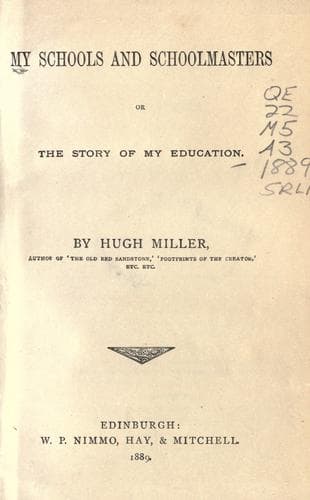
My Schools and Schoolmasters; Or, The Story of My EducationMiller, Hugh
Philosophy
My Schools and Schoolmasters; Or, The Story of My Education
Miller, Hugh
Education -- Scotland -- History -- 19th century; Geologists -- Scotland -- Biography; Miller, Hugh, 1802-1856 -- Knowledge and learning
One of my discoveries of this early period would have been deemed a not
unimportant one by the geologist. Among the woods of the hill, a short
half-mile from the town, there is a morass of comparatively small
extent, but considerable depth, which had been laid open by the bursting
of a waterspout on the uplands, and in which the dark peaty chasm
remained unclosed, though the event had happened ere my birth, until I
had become old and curious enough thoroughly to explore it. It was a
black miry ravine, some ten or twelve feet in depth. The bogs around
waved thick with silvery willows of small size; but sticking out from
the black sides of the ravine itself, and in some instances stretched
across it from side to side, lay the decayed remains of huge giants of
the vegetable world, that had flourished and died long ages ere, in at
least our northern part of the island, the course of history had begun.
There were oaks of enormous girth, into whose coal-black substance one
could dig as easily with a pickaxe as one digs into a bank of clay; and
at least one noble elm, which ran across the little stream that
trickled, rather than flowed, along the bottom of the hollow, and which
was in such a state of keeping, that I have scooped out of its trunk,
with the unassisted hand, a way for the water. I have found in the
ravine--which I learned very much to like as a scene of exploration,
though I never failed to quit it sadly bemired--handfuls of hazel-nuts,
of the ordinary size, but black as jet, with the cups of acorns, and
with twigs of birch that still retained almost unchanged their silvery
outer crust of bark, but whose ligneous interior existed as a mere pulp.
I have even laid open, in layers of a sort of unctuous clay, resembling
fuller's earth, leaves of oak, birch, and hazel, that had fluttered in
the wind thousands of years before; and there was one happy day in which
I succeeded in digging from out the very bottom of the excavation a huge
fragment of an extraordinary-looking deer's horn. It was a broad,
massive, strange-looking piece of bone, evidently old-fashioned in its
type; and so I brought it home in triumph to Uncle James, as the
antiquary of the family, assured that he could tell me all about it.
Uncle James paused in the middle of his work; and, taking the horn in
his hand, surveyed it leisurely on every side. "That is the horn, boy,"
he at length said, "of no deer that now lives in this country. We have
the red deer, and the fallow deer, and the roe; and none of them have
horns at all like that. I never saw an elk; but I am pretty sure this
broad, plank-like horn can be none other than the horn of an elk." My
uncle set aside his work; and, taking the horn in his hand, went out to
the shop of a cabinet-maker in the neighbourhood, where there used to
work from five to six journeymen. They all gathered round him to examine
it, and agreed in the decision that it was an entirely different sort of
Public-domain text, read in full here on John Shaqi.
Reviews
Reviews
No reviews yet
Be the first to share your thoughts on this work.
Elsewhere in the archive
Join the Discussion
Join the discussion
Sign in to leave a comment or review.
Sign InorCreate an account