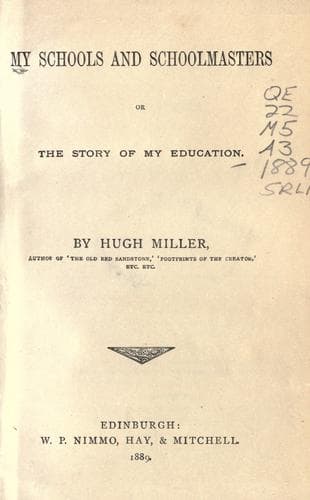
My Schools and Schoolmasters; Or, The Story of My EducationMiller, Hugh
Philosophy
My Schools and Schoolmasters; Or, The Story of My Education
Miller, Hugh
Education -- Scotland -- History -- 19th century; Geologists -- Scotland -- Biography; Miller, Hugh, 1802-1856 -- Knowledge and learning
My cousin William, the merchant, had, as I have said, many guests; but
they were all too grand to take any notice of me. There was, however,
one delightful man, who was said to know a great deal about rocks and
stones, that, having heard of my fine large crystals, desired to see
both them and the boy who had found them; and I was admitted to hear him
talk about granites, and marbles, and metallic veins, and the gems that
lie hid among the mountains in nooks and crannies. I am afraid I would
not now deem him a very accomplished mineralogist: I remember enough of
his conversation to conclude that he knew but little, and that little
not very correctly: but not before Werner or Hutton could I have bowed
down with a profounder reverence. He spoke of the marbles of Assynt--of
the petrifactions of Helmsdale and Brora--of shells and plants embedded
in solid rocks, and of forest trees converted into stone; and my ears
drank in knowledge eagerly, as those of the Queen of Sheba of old when
she listened to Solomon. But all too soon did the conversation change.
My cousin was mighty in Gaelic etymology, and so was the mineralogist;
and while my cousin held that the name of the Barony of Gruids was
derived from the great hollow tree, the mineralogist was quite as
certain that it was derived from its syenite, or, as he termed it, its
_granite_, which resembled, he remarked, from the whiteness of its
feldspar, a piece of curd. _Gruids_, said the one, means the place of
the great tree; _Gruids_, said the other, means the place of the curdled
stone. I do not remember how they settled the controversy; but it
terminated, by an easy transition, in a discussion respecting the
authenticity of Ossian--a subject on which they were both perfectly
agreed. There could exist no manner of doubt regarding the fact that the
poems given to the world by Macpherson had been sung in the Highlands by
Ossian, the son of Fingal, more than fourteen hundred years before. My
cousin was a devoted member of the Highland Society; and the Highland
Society, in these days, was very much engaged in ascertaining the right
cut of the philabeg, and in determining the chronology and true sequence
of events in the Ossianic age.
Public-domain text, read in full here on John Shaqi.
Reviews
Reviews
No reviews yet
Be the first to share your thoughts on this work.
Elsewhere in the archive
Join the Discussion
Join the discussion
Sign in to leave a comment or review.
Sign InorCreate an account