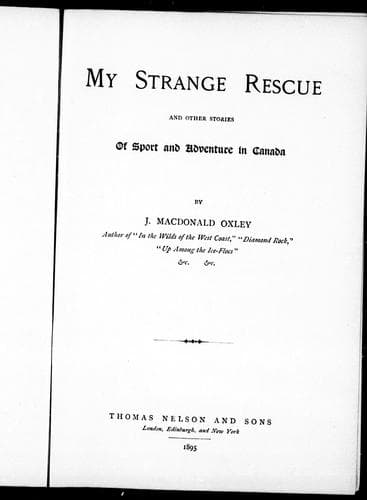
My Strange Rescue, and Other Stories of Sport and Adventure in CanadaOxley, J. Macdonald (James Macdonald)
General
My Strange Rescue, and Other Stories of Sport and Adventure in Canada
Oxley, J. Macdonald (James Macdonald)
Canada -- Juvenile fiction; Canada -- Juvenile literature
When in the gray, grim morning they came to reckon up, they found, to
their dismay, that with six months of hopeless captivity before them,
they had barely enough food for forty days, allowing the scantiest of
daily rations to each of the sixty-five men who had survived the
shipwreck.
The sequel, as related with simple, graphic pathos by Father Crespel,
one of the few who ultimately emerged from the terrible ordeal,
constitutes as grand a record of human courage and endurance and as
harrowing a history of human suffering as ever has been told.
The poor castaways had nothing but a little canvas to shelter them from
the keen, biting blasts. Fever presently broke out amongst them. Then
half of them set forth in two small boats to coast around that merciless
shore for forty leagues, after which they made a hazardous dash across
twelve leagues of open sea to Mingan, where French fishermen were known
to winter.
The "jolly-boat" was swamped after they had been five days out, and its
thirteen occupants were thus spared further misery. At last the ice
setting in made the progress of the other boat impossible, and they had
no alternative but to go into winter quarters and wait for the tardy
spring.
With two pounds of damp, mouldy flour and two pounds of unsavoury
fox-meat per day, these seventeen men, housed in rude huts of spruce
boughs, prepared to endure the long agony of winter. Once a week a
spoonful of peas was served out to each man; which constituted such a
treat that, as Father Crespel naively puts it, "On those days we had our
best meal."
Hunger, cold, and disease carried off one by one as the months dragged
themselves along, until at length only three still lived, when a band of
Indians came just in time to save this remnant from perishing.
All this and more is told by heroic Father Crespel with a quaint
simplicity, a minuteness of detail, and a perfect submission to the
Divine will, that renders his recital extremely touching.
Not less saddening is the story of the stout brig _Granicus_, which in
1828 went to pieces off the east end of the island, also in the month of
November. Many of the crew escaped to land, but with little more than
the clothing they wore.
[Illustration: "HUNGER, COLD, AND DISEASE CARRIED OFF ONE BY ONE, UNTIL
ONLY THREE STILL LIVED. _Page_ 252"]
Winter soon closed in upon them. No succour came. Their provisions gave
out, and what followed may be judged from the awful sight that met the
eyes of some government officials when the following spring they
stumbled across a rude hut strewn with human skeletons, and, in the pot
that hung over the long-dead ashes, some bones that were not those of an
animal.
Public-domain text, read in full here on John Shaqi.
Reviews
Reviews
No reviews yet
Be the first to share your thoughts on this work.
Elsewhere in the archive
Join the Discussion
Join the discussion
Sign in to leave a comment or review.
Sign InorCreate an account