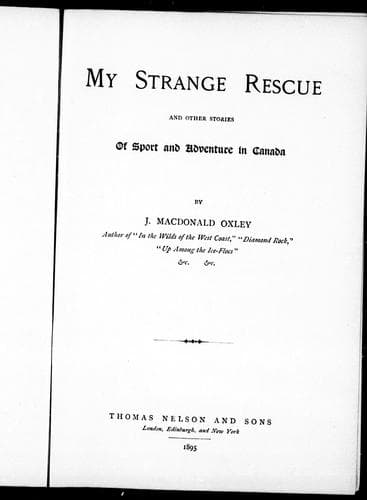
My Strange Rescue, and Other Stories of Sport and Adventure in CanadaOxley, J. Macdonald (James Macdonald)
General
My Strange Rescue, and Other Stories of Sport and Adventure in Canada
Oxley, J. Macdonald (James Macdonald)
Canada -- Juvenile fiction; Canada -- Juvenile literature
I will now try to describe the game as it is played by the Canadian
clubs to-day. The ground should be a smooth, level field one hundred
and fifty yards in length by one hundred in breadth at the very least,
and for championship matches another fifty yards each way is most
desirable. The goals should be one hundred and twenty-five yards apart,
but a lesser distance may be agreed upon between the two captains if the
nature of the ground requires it. The side boundaries are formed by the
fence or ring of spectators, as the case may be. If the ball goes over
the one, or gets tangled up with the other, it has to be brought out and
"faced." The nature of "facing" will be explained further on. The
goals are simply two poles six feet high and six feet apart, and in
front of them, at a lacrosse stick’s length from their base, a line is
marked with whitewash, inside of which no attacking player must enter
unless the ball has preceded him. If he enters in advance of the ball,
the goal-keeper may drive him out at the point of his stick, and use any
violence necessary for that purpose.
The side consists of twelve players and a captain. The captain does not
play; he simply runs round and shouts at the other fellows. It looks
like an easy job, but it is far from being so. Upon the captain very
often depends the fate of his team, and he should always be a cool,
clear-headed, experienced player, thoroughly up to all the tricks and
subtleties of the game. The lacrosse-sticks, or crosses as they are
called, are light, strong sticks, made of either hickory, ash, or rock
elm; the Indian preferring the first because of its strength, and the
white man the other two because of their lightness. There is no rule as
to the length of a stick, but practical experience has shown that the
most convenient length is equal to the distance from the toe to the
hollow under the arm. Each player can therefore suit himself in the
matter. The netting is of gut, and should be about twenty-nine inches
long, and must not be more than twelve inches wide at its widest part.
Nine inches is a good average width. There must be no "bag" to the
netting, and to guard against this the referee is required to inspect
the crosses carefully before allowing the match to begin. The ball is
of sponge india-rubber, about half-an-inch less in circumference than a
base-ball, and weighing about four ounces. It should bounce freely, as
this adds greatly to the uncertainty and interest of the game.
Public-domain text, read in full here on John Shaqi.
Reviews
Reviews
No reviews yet
Be the first to share your thoughts on this work.
Elsewhere in the archive
Join the Discussion
Join the discussion
Sign in to leave a comment or review.
Sign InorCreate an account