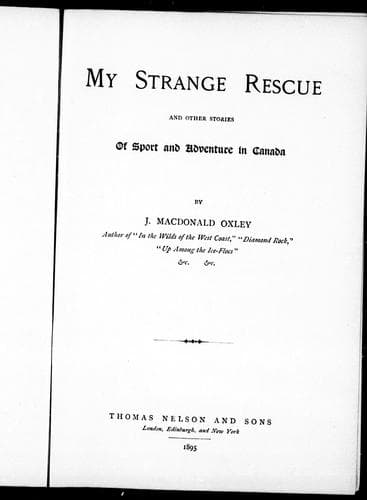
My Strange Rescue, and Other Stories of Sport and Adventure in CanadaOxley, J. Macdonald (James Macdonald)
General
My Strange Rescue, and Other Stories of Sport and Adventure in Canada
Oxley, J. Macdonald (James Macdonald)
Canada -- Juvenile fiction; Canada -- Juvenile literature
The shocking story was published far and wide that a winter that did not
change to spring in the usual way had cut off their supply of food, and
that in consequence they were devouring one another with the ghastly
relish of a Fiji cannibal. Although this report proved untrue, happily,
the Eskimos are sufficiently interesting to attract attention at all
times, and are little enough known to furnish an adequate excuse at this
time for a brief paper upon them.
*I.*
To aid me in presenting the earliest glimpses of the Eskimos, I am
fortunate in having before me a manuscript prepared by the late Robert
Morrow of Halifax, Nova Scotia, an accomplished student of the
literatures of Iceland and Denmark.
That to the Norsemen and not to the Spaniards rightfully belongs the
credit of first discovering America is now settled, and that when the
Norsemen first touched American soil they found the Eskimos already in
possession is also certain. Yet it was not these bold adventurers that
gave these curious people the name by which they are most commonly
known. In the expressive Norse tongue they were described as
"Skraelings"—that is, the "chips, parings." The intention was not, of
course, to convey the idea that they were cordially accepted as "chips
of the old block," but, on the contrary, to show that they were regarded
by their handsome and stalwart discoverers as little better than mere
fragments of humanity—a view which, however unflattering, their squat
stature, ugly countenances, and filthy habits went far to justify.
The name "Eskimo" was given to them by the Abenaki, a tribe of Indians
in southern Labrador. It is an abbreviation of "Eskimautsik," which
means "eating raw fish," in allusion to their repulsive custom of eating
both fish and flesh without taking the preliminary trouble of cooking
it. The Eskimos themselves assert very emphatically that they are
"Innuit"—that is, "the people"—just as though they were the only people
in the world (and, by the way, it is worth noticing that each particular
tribe of these "Huskies" thinks itself the entire population of the
globe until undeceived by the advent of visitors). Their national name,
if they have one at all, is "Karalit," the plural of "Karalik," meaning
"those that stayed behind."
Public-domain text, read in full here on John Shaqi.
Reviews
Reviews
No reviews yet
Be the first to share your thoughts on this work.
Elsewhere in the archive
Join the Discussion
Join the discussion
Sign in to leave a comment or review.
Sign InorCreate an account