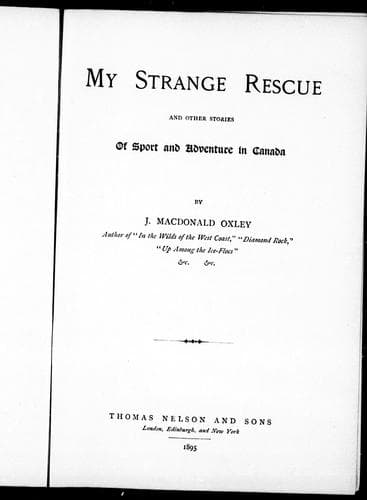
My Strange Rescue, and Other Stories of Sport and Adventure in CanadaOxley, J. Macdonald (James Macdonald)
General
My Strange Rescue, and Other Stories of Sport and Adventure in Canada
Oxley, J. Macdonald (James Macdonald)
Canada -- Juvenile fiction; Canada -- Juvenile literature
With reference to this latter title, Mr. Morrow points out a curious
fact, which is suggestive. Strahlenburg, in his description of the
northern part of Asia, states, on the authority of the Tartar writer
Abulgazi Chan, that Og, or Ogus Chan, who reigned in Tartary long before
the birth of Christ, made an inroad into the southern Asiatic countries,
and as some of his tribes stayed behind, they were called in reproach
"Kall-atzi," and also "Karalik." Now this "Karalik," with its plural
"Karalit," is the very name that the Eskimos give themselves. So
striking a resemblance, amounting in fact to identity, can surely be
accounted for in no other way (and for this suggestion I must assume all
responsibility) than that those who stayed behind in Tartary
subsequently moved over to the American continent.
When Eric the Red sailed across from Iceland to Greenland (somewhere
about the year 985), he found many traces of the Eskimos there: and when
Thorvald, some twenty years later, ventured as far south as Vinland,
identified as the present Martha’s Vineyard (with which he was so
delighted that he exclaimed, "Here is a beautiful land, and here I wish
to raise my dwelling"), the unexpected discovery of three skin boats
upon the beach affected him and his followers much as the imprint of a
human foot did Robinson Crusoe. They found more than the boats,
however, for each boat held three men, all but one of whom they caught
and summarily despatched, for reasons that the saga discreetly forbears
to state.
But retribution followed fast. No sooner had the invaders returned to
their ships than the Skraelings attacked them in great force, and
although the Norsemen came out best in the fighting, their leader,
Thorvald, received a mortal wound. He charged his men to bury him upon
the cape "at which he had thought it best to dwell;" for, as he
pathetically added, "it may happen that it was a true word that fell
from my mouth that I should dwell here for a time." His men did as they
were bid. They set up two crosses over his grave, whose site is now
known as Summit Point. They then hastened homeward.
Public-domain text, read in full here on John Shaqi.
Reviews
Reviews
No reviews yet
Be the first to share your thoughts on this work.
Elsewhere in the archive
Join the Discussion
Join the discussion
Sign in to leave a comment or review.
Sign InorCreate an account