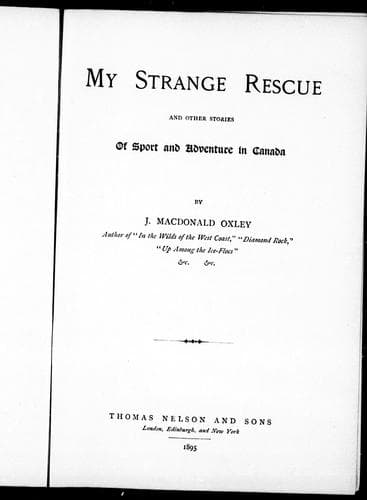
My Strange Rescue, and Other Stories of Sport and Adventure in CanadaOxley, J. Macdonald (James Macdonald)
General
My Strange Rescue, and Other Stories of Sport and Adventure in Canada
Oxley, J. Macdonald (James Macdonald)
Canada -- Juvenile fiction; Canada -- Juvenile literature
Snow-shoeing disputes with tobogganing the honour of being Canada’s
national winter sport; for although snow-shoes have been seen in Siberia
and Tartary, and are used to some extent in Scandinavia, in none of
these places do the people derive much amusement from them. Simple as
the snow-shoe seems, I would not advise any one to try to make a pair
for himself. Only the Indians can do this really well, and even in
Canada the vast majority of shoes are put together by dusky hands.
This is how they make a shoe of three feet six inches, which is a fair
average size:—A piece of light ash about half-an-inch thick, and at
least ninety inches in length, is bent to a long oval until the two ends
touch, when they are lashed strongly together with catgut. Two strips
of tough wood about an inch broad are then fitted across this frame, one
being placed about five inches from the curving top, the other some
twenty inches from the tapering end. The object of these strips is to
give both strength and spring to the shoe. The three sections into
which the interior of the frame has thus been divided are then woven
across with catgut, each having a different degree of fineness in the
mesh, the top section being very fine, the middle section, upon which
almost the whole strain comes, coarse and strong, and the end section a
medium grade between the other two. The gut in the middle section is
wound right around the framework for the sake of greater strength, but
in the other two is threaded through holes bored at intervals of an inch
or so. Just behind the front cross-bar an opening about four inches
square is left in the gut netting, in order to allow free play for the
toes in lifting the shoe at each step. Both wood and gut must be
thoroughly seasoned, or else the one will warp, and the other stretch
and sag until the shoe is altogether useless.
The shoes are made in many shapes and of many sizes, ranging from two to
six feet in length, and from ten to twenty inches in breadth. But for
all practical purposes a shoe measuring three feet six inches by twelve
or fifteen inches is the best. In racing, narrower shoes are used, but
they rarely go below ten inches, that being the regulation measurement
for club competitions. Then, again, some snow-shoes are turned up in
front like tiny toboggans, instead of being flat, this kind being worn
principally by ladies.
Public-domain text, read in full here on John Shaqi.
Reviews
Reviews
No reviews yet
Be the first to share your thoughts on this work.
Elsewhere in the archive
Join the Discussion
Join the discussion
Sign in to leave a comment or review.
Sign InorCreate an account