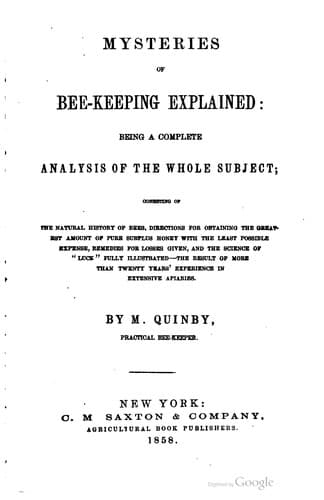
Mysteries of Bee-keeping ExplainedQuinby, M. (Moses)
Science
Mysteries of Bee-keeping Explained
Quinby, M. (Moses)
Bees
After all, bees being robbed is like being destroyed by worms; a kind
of secondary matter; that is, not one strong stock in a hundred will
ever be attacked and plundered on the first onset. Bees must be first
tempted, and rendered furious by a weak hive; a dish of refuse honey
set near them is sometimes sufficient to set them at work, also where
they have been fed and not had a full supply. After they have once
commenced, it takes an astonishing quantity to satiate their appetite.
They seem to be perfectly intoxicated, and regardless of danger; they
venture on to certain destruction! I have known a few instances where
good stocks by this means were reduced, until they in turn fell a prey
to others. I have for several years kept about one hundred stocks away
from home, where I could not see them much, to prevent robbing. Yet I
never lost a stock by this cause. I simply keep the entrance closed,
except a passage for the bees at work during spring. It is true I have
lost a few stocks, when the other bees took the honey, but they would
have been lost any way.
SPRING THE WORST TIME.
As I before remarked in the commencement of this chapter, bees will
plunder and fight at any time through the summer, when honey cannot be
collected; but _spring_ is the only time that such desperate and
persevering efforts are made to obtain it. It is the only time the
apiarian can be excused for having his hives plundered, or letting them
stand in a situation for it. We then often have families reduced in
winter and spring, from various causes, and when protected through this
season, generally make good stocks. It is then we wish them to form
steady, industrious habits, and not live by plunder. Prevention is
better than cure; evil propensities should be checked in the beginning.
The bee, like man, when this disposition has been indulged for a time,
it is hard breaking the habit; a severe chastisement is the only cure;
they too go on the principle of much wanting more.
NO NECESSITY TO HAVE THE BEES PLUNDERED IN THE FALL.
The apiarian having his bees plundered in the fall, is not fit to have
charge of them; their efforts are seldom as strong as in spring,
(unless there is a general scarcity,) the weak hives are usually better
supplied with bees, and consequently a less number is exposed; but yet,
when there are some very weak families, these should be taken away as
soon as the flowers fail, or strengthened with bees from another hive.
Particulars in fall management.
Public-domain text, read in full here on John Shaqi.
Reviews
Reviews
No reviews yet
Be the first to share your thoughts on this work.
Elsewhere in the archive
Join the Discussion
Join the discussion
Sign in to leave a comment or review.
Sign InorCreate an account