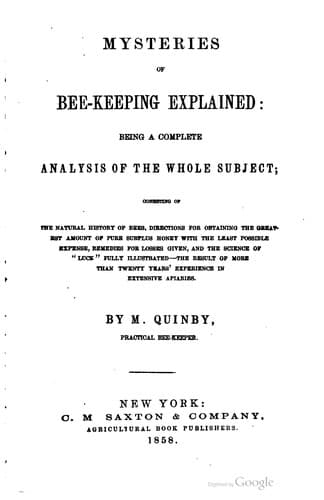
Mysteries of Bee-keeping ExplainedQuinby, M. (Moses)
Science
Mysteries of Bee-keeping Explained
Quinby, M. (Moses)
Bees
If it is wished to wait as long as possible, and not lose the bees, a
test will be necessary to decide how long it will do to delay feeding.
In this case, _strict attention will be necessary; they will need
examination every morning_. If a light tap on the hive is answered b; a
brisk, lively buzzing, they are not suffering yet; but if no answer is
returned to your inquiry, it indicates a want of strength. Extreme
destitution destroys all disposition to repel an attack. Sometimes a
part of the bees will be too weak to remain among the combs, and will
be lying on the bottom, and some few outside. If the weather is cool,
they appear to be lifeless; yet they can be revived, and now _must he
fed_.
DIRECTIONS FOR FEEDING.
Those among the combs may be able to move, though feebly. When this is
the condition of things, invert the hive, gather up all the scattered
bees, and put them in. Get some honey; if candied, heat it till it
dissolves; comb honey is not so good without mashing; if no honey is to
be had, brown sugar may be taken instead; add a little water, and boil
it till about the consistence of honey, and skim it; when cool enough,
pour a quantity among the combs, directly on the bees; cover the bottom
of the hive with a cloth, securing it firmly, and bring to the fire to
warm up. In two or three hours they will be revived, and may be
returned to the stand, providing the honey given is all taken up; on no
account let any honey run out around the bottom. The necessity of a
daily visit to the hives is apparent from the fact, that if left over
for one day, in the situation just described, it will be too late to
revive them. At night, if you have a box cover, such as I have
recommended, you may open the holes in the top of the hive; fill a
small baking dish with honey or syrup, and set it on the top; put in
some shavings to keep the bees from drowning, or a float may be used if
you choose; it should be made of some very light wood, very thin, and
full of holes or narrow channels, made with a saw. At the commencement
of feeding, a few drops should be scattered on the top of the hive and
trailed to the side of the dish, to teach them the way; after feeding a
few times, they will know the road. When the weather is warm enough for
them to take it during the night, it is best to feed at evening,--from
four to eight ounces daily, is sufficient. If the family is very small,
what honey is left in the morning may attract other bees; it is then
best to take it out, or carry the hive in the house to a dark room,
sufficiently warm, and feed them enough to last several days, and then
return them to the stand; keeping a good lookout that they are not
plundered, and again in a starving condition, until flowers produce
honey sufficient.
WHOLE FAMILIES MAY DESERT THE HIVE.
Public-domain text, read in full here on John Shaqi.
Reviews
Reviews
No reviews yet
Be the first to share your thoughts on this work.
Elsewhere in the archive
Join the Discussion
Join the discussion
Sign in to leave a comment or review.
Sign InorCreate an account