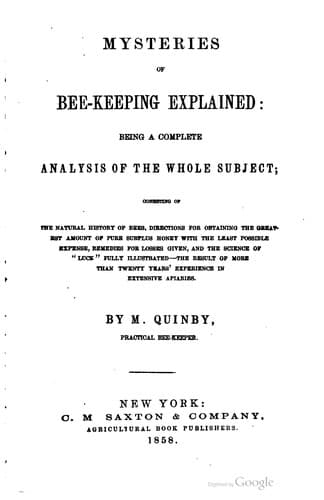
Mysteries of Bee-keeping ExplainedQuinby, M. (Moses)
Science
Mysteries of Bee-keeping Explained
Quinby, M. (Moses)
Bees
An inch hole in the side of the hive, a few inches from the bottom, as
a passage for the bees, is needed, as I shall recommend letting the
hive close to the board; it is essential on account of robbing; also,
it is necessary to confine as much as possible the animal heat, in most
hives, during the season the bees are engaged in rearing young brood;
and warmth is necessary to hatch the eggs, and develop the larvæ; we
all know that when the hive is close, less heat will pass off than if
raised an inch.
OBJECTION ANSWERED.
You object to this, and tell me, "the worms will get between the bottom
of the hive and the board." Well, I think they will, and what then? Why
I expect if you intend to succeed, that you will get them out, and
crush their heads; if you cannot give as much attention as this, better
not keep them, or let some one have the care of them that will. I am as
willing to find a worm under the edge of the hive, and dispatch it, as
to have it creep into some place out of sight, and change to the moth.
I once trimmed off the bottom of my hives to a thin edge, so they did
not have this place for their cocoons, but now prefer to have them
square. _All profit_ is seldom obtained with anything. If you plant a
field with corn, you do not expect that the whole work for the crop is
finished. Neither should you expect when you set up a stock of bees,
that a full yield will be realized without something more. If you are
remunerated by keeping the weeds from your corn, be assured it is
equally profitable to weed out your bees.
INSUFFICIENCY OF INCLINED BOTTOM-BOARD.
Now do not be deceived in this matter, and through indolence be induced
to get those hives with descending bottom-boards, to throw out the
worms as they fall, and hope by that means to get rid of the trouble;
(I have already, in another chapter, expressed doubts of this). But we
will _now_ suppose such descending bottom-boards capable of throwing
every worm that touches it "heels over head" to the ground; what have
we gained? His neck is not broken, nor any other _bone_ of his body! As
if nothing extraordinary had happened, he quietly gathers himself up,
and looks about for snug quarters; he cares not a fig for the hive now;
he gormandized on the combs until satisfied, before he left them, and
is glad to get away from the bees any how. A place large enough for a
cocoon is easily found, and when he again becomes desirous of visiting
the hives, it is not to satisfy his own wants, but to accommodate his
progeny; he is then furnished with wings ample to carry him to any
height that you choose to put your bees.
A MOTH CAN GO WHERE BEES CAN.
A hive that is proof against the moth, is yet to be constructed. We
frequently hear of them, but when they come to be tested, somehow these
worms get where the bees are. When your hives become so full of bees,
that they cover the board in a cool morning, the worms will be seldom
found there, except under the edge of the hive.
Public-domain text, read in full here on John Shaqi.
Reviews
Reviews
No reviews yet
Be the first to share your thoughts on this work.
Elsewhere in the archive
Join the Discussion
Join the discussion
Sign in to leave a comment or review.
Sign InorCreate an account