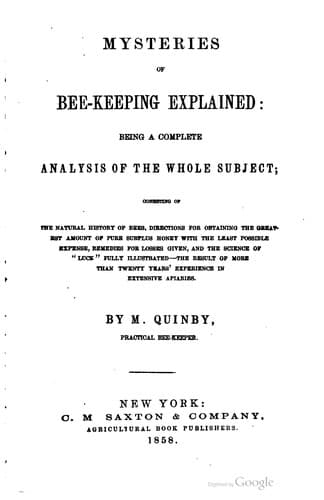
Mysteries of Bee-keeping ExplainedQuinby, M. (Moses)
Science
Mysteries of Bee-keeping Explained
Quinby, M. (Moses)
Bees
Two weeks is the shortest time I ever had any filled and finished.
This, of course, depends on the yield of honey, and size of the swarm;
three or four weeks are usually taken for the purpose. I have before
said that the first yield of honey nearly fails in this section,
usually about the 20th of July; there are some variations, later or
earlier, according to the season. In other places it may be much later.
WHEN TO TAKE OFF BOXES PART FULL.
It can be ascertained by occasionally raising the cover to your glass
boxes. When no more is being added, all boxes that are worth the
trouble should be taken off; if left longer the comb gets darker, and
such cells of honey as are not sealed over, (and sometimes the majority
are such,) the bees generally remove down into the hive.
TOBACCO SMOKE PREFERRED TO SLIDES.
When boxes are to be taken off, if a slide of tin, zinc, &c., is used
to close the holes, some of the bees are apt to be crushed, others will
find themselves minus a head, leg, or abdomen, and all of them be
irritable for several days. A little tobacco smoke is preferable, as it
keeps all quiet. Just raise the box to be taken off sufficient to puff
under it some smoke, and the bees will leave the vicinity of the holes
in an instant; the box can then be removed, and another put on if
necessary, without exciting their anger in the least.
MANNER OF DISPOSING OF THE BEES IN THE BOXES.
Arouse the bees by striking the box lightly four or five times. If all
the cells are finished, and honey is still obtained, turn the box
bottom up, near the hive from which it was taken, so that the bees can
enter it without flying; by this means you can save several young bees,
that have never left the hive and marked the location, and a few others
too weak to fly, but will follow the others into the hive; (such are
lost when we are obliged to carry them at a distance.) Boxes can be
taken off either in the morning or evening; if in the morning, it may
stand several hours when the sun is not too hot, but on no account let
it stand in the sun in the middle of the day, as the combs will melt.
The bees will all leave, sometimes in an hour; at others they will not
be out in three. They may be taken off at evening and stand till
morning, in fair weather; if not too cool, they are generally all out;
but here is some risk of the moth finding it and depositing her eggs;
perhaps one in fifty may be thus found.
BEES DISPOSED TO CARRY AWAY HONEY.
Public-domain text, read in full here on John Shaqi.
Reviews
Reviews
No reviews yet
Be the first to share your thoughts on this work.
Elsewhere in the archive
Join the Discussion
Join the discussion
Sign in to leave a comment or review.
Sign InorCreate an account