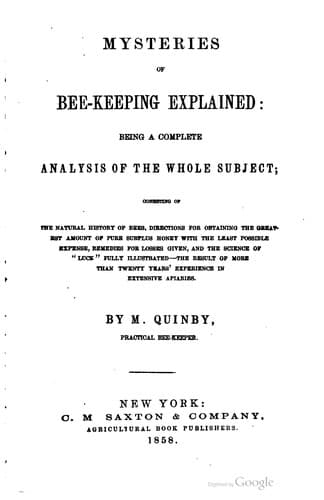
Mysteries of Bee-keeping ExplainedQuinby, M. (Moses)
Science
Mysteries of Bee-keeping Explained
Quinby, M. (Moses)
Bees
When the boxes are free from the bees, two things are to be prevented,
if we wish to save our honey till cold weather. One is to keep out the
worms, the other to prevent souring. The last may be new to many, but
some few of us have had it caused by dampness in warm weather. The
combs become covered with moisture, a portion of the honey becomes thin
like water, and instead of the saccharine qualities we have the acid.
Remedy: keep perfectly dry and cool, if you can, but dry at any rate.
APT TO BE DECEIVED ABOUT THE WORMS.
But the worms, you can surely keep them out, you think, since you can
seal up the boxes perfectly close, preventing the moth or even the
smallest ant from entering! Yes, you may do this effectually, but the
worms will often be there somehow, unless in a very low temperature,
such as a very cool cellar, or in house, and then you have dampness to
guard against. I have a little experience in this matter that spoils
your theory entirely. I have taken off glass jars, and watched them
till the bees were all out, and was _certain the moth did not come
near_ them, then immediately sealed them up; absolutely preventing
access afterwards, (I could do this with a jar more effectually than a
box which is made of several pieces,) I then felt quite sure that I was
ahead, and should have no trouble with the worms, as had often been the
case before. I was sadly mistaken.
THEIR PROGRESS DESCRIBED.
In a few days, I could see at first a little white dust, like flour, on
the side of the combs, and on the bottom of the jar. As the worms grew
larger, this dust was coarser. By looking closely at the combs, a small
white thread-like line was first perceptible, enlarging as the worm
progressed.
When combs are filled with honey, they go only on the surface, eating
nothing but the sealing of the cells; seldom penetrating to the centre,
without an empty cell to give the chance. Disgusting as they seem to
be, they dislike being daubed with honey. _Wax, and not honey, is their
food._
The reader would like to know how these worms came in the jars, when,
to all appearance, it _was a physical impossibility_. I would like to
tell positively, but cannot. But I will guess, if you will allow it. I
will first premise, that I do not suppose they are generated
spontaneously! Their being found there, then, would indicate some agent
or means not readily perceived.
A SOLUTION OFFERED.
The hypothesis that I offer is original and new, and therefore open for
criticism; if there is a better way to account for the mystery, I would
be glad to know it.
Public-domain text, read in full here on John Shaqi.
Reviews
Reviews
No reviews yet
Be the first to share your thoughts on this work.
Elsewhere in the archive
Join the Discussion
Join the discussion
Sign in to leave a comment or review.
Sign InorCreate an account