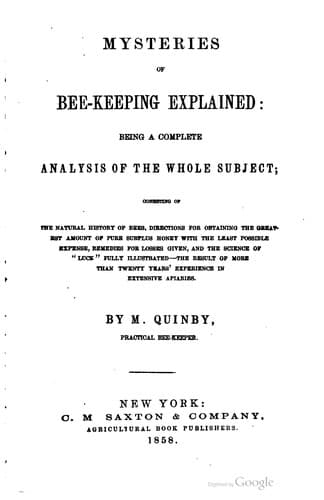
Mysteries of Bee-keeping ExplainedQuinby, M. (Moses)
Science
Mysteries of Bee-keeping Explained
Quinby, M. (Moses)
Bees
Now, whether you are satisfied or not with the foregoing, we will
proceed with the remedy. Perhaps you may find one box in ten that will
have no worms about it, others may contain from one to twenty when they
have been off a week or more. All the eggs should have a chance to
hatch, which in cool weather may be three weeks. They should be
watched, that no worms get large enough to injure the combs much,
before they are destroyed. Get a close barrel or box that will exclude
the air as much as possible; in this put the boxes, with the holes or
bottom open. In one corner leave a place for a cup or dish of some
kind, to hold some sulphur matches while burning. (They are made by
dipping paper or rags in melted sulphur.) When all is ready, ignite the
matches, and cover close for several hours. A little care is required
to have it just right: if too little is used, the worms are not killed;
if too much, it gives the combs a green color. A little experience will
soon enable you to judge. If the worms are not killed on the first
trial, another dose must be administered. Much less sulphur will adhere
to paper or rags, if it is very hot, when dipped, than when just above
the temperature necessary to melt it; this should be considered, as
well as the number of boxes to be smoked, size of the vessel used in
smoking them, &c.
Whether this gas from burning sulphur will destroy the eggs of the moth
before the worm appears, I have not tested sufficiently to decide; but
I do know that it is an effectual quietus for the larvæ!
FREEZING DESTROYS THEM.
Boxes taken off at the end of warm weather, and exposed in a freezing
situation through the winter, appear to have all the worms as well as
eggs for them destroyed by the cold; consequently, all boxes so
exposed, may be kept any length of time; the only care being necessary,
to shut out the moth effectually. But don't forget to look out for all
combs from which the bees have been removed in warm weather. I prefer
taking off all boxes at the end of the first yield of honey, even when
I expect to put them on again for buckwheat honey. The bees at this
season collect a great abundance of propolis, which they spread over
the inside of the boxes as well as hive; in some instances it is spread
on the glass so thick as to prevent the quality of honey being seen.
There is no necessity for boxes on a hive at any season when there is
no yield of honey to fill them. Sometimes even in a yield of buckwheat
honey, a stock may contain too few bees to fill boxes, but just a few
may go into them and put on the propolis; this should not be allowed,
as it makes it look bad when used another year. At this season,
(August) some old stocks may be full of combs, and but few bees, but
swarms when they have got the hive full in time, are very sure to have
bees enough to go into the boxes to work. I have known them to do so in
three weeks after being hived.
OBJECTION TO USING BOXES BEFORE THE HIVE IS FULL.
Public-domain text, read in full here on John Shaqi.
Reviews
Reviews
No reviews yet
Be the first to share your thoughts on this work.
Elsewhere in the archive
Join the Discussion
Join the discussion
Sign in to leave a comment or review.
Sign InorCreate an account