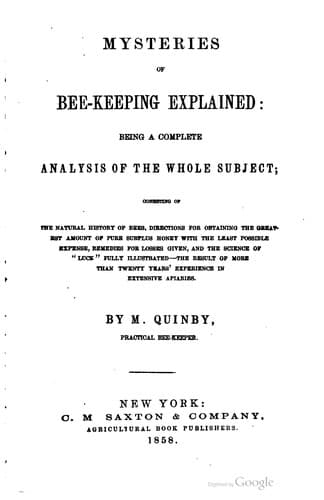
Mysteries of Bee-keeping ExplainedQuinby, M. (Moses)
Science
Mysteries of Bee-keeping Explained
Quinby, M. (Moses)
Bees
The bees when first rising from the hive, describe circles of but few
feet, but as they recede, they spread over an area of several rods.
Their movement are much slower than usual, in a few minutes thousands
may be seen revolving in every possible direction! A swarm may be seen
and heard, at a distance, where fifty hives, ordinarily at work, would
not be noticed! When about out of the hive, or soon after, some branch
of a tree or bush is usually selected on which to cluster. In less than
half a minute after the spot is indicated, even when the bees are
spread over an acre, they are gathered in the immediate vicinity, and
all cluster in a body from five to ten minutes after leaving the hive.
They should now be hived immediately, as they show impatience if left
long, especially in the sun; also, if another stock should send out a
swarm while they were hanging there, they would be quite sure to mix
together.
MANNER OF HIVING CAN BE VARIED.
It makes but little difference what way they are put in the hive,
providing they are all made to go in. Proceed as is most convenient; an
old table or bench is very good to keep them out of the grass if there
should happen to be any; if there is not much in the way, lay your
bottom-board on the ground, make it level, set your hive on it, and
raise one edge an inch or more to give the bees a chance to enter.
USUAL METHOD.
Cut off the branch with the bees, if it can be done as well as not, and
shake it in front of the hive, a portion will discover it, and will at
once commence a vibration of their wings; this, I suppose, is a call
for the others. A knowledge of a new home being found seems to be
communicated in this way, as it is kept up until all are in. A great
many are apt to stop about the entrance, thereby nearly or quite
closing it, and preventing others going in, when they will gather on
the outside. You can expedite the matter with a stick or quill, by
gently pushing them away; and another portion will enter. When gentle
means will not induce them to go in, in a reasonable time, and they
appear obstinate, a little water sprinkled on them will facilitate
operations greatly, when nothing else will. (Be careful and not over-do
the matter, by using too much water, they can be so wet as not to move
at all.)
When they cluster on a branch that you do not wish to cut off, place
your bottom-board as near as convenient; on it lay two sticks about an
inch in diameter, of the same length: try the hive, and see that all is
right; then turn it bottom up, directly under the main part of the
cluster; if you have an assistant, let him jar the branch sufficiently
to detach the bees; most of them will fall directly into the hive. If
no assistant is at hand it is unnecessary to wait, (I have done it a
hundred times without help); with the bottom of the hive strike the
under side of the branch hard enough to dislodge them, then turn it on
the board; the sticks will prevent the bottom crushing many bees.
Public-domain text, read in full here on John Shaqi.
Reviews
Reviews
No reviews yet
Be the first to share your thoughts on this work.
Elsewhere in the archive
Join the Discussion
Join the discussion
Sign in to leave a comment or review.
Sign InorCreate an account