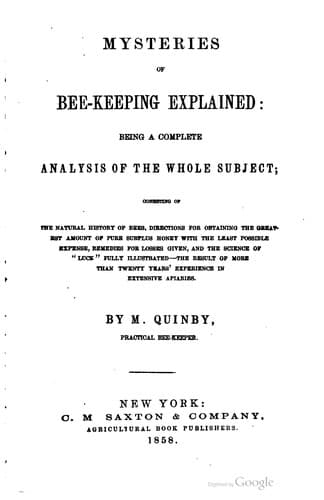
Mysteries of Bee-keeping ExplainedQuinby, M. (Moses)
Science
Mysteries of Bee-keeping Explained
Quinby, M. (Moses)
Bees
When the old queen is actually lost, and the bees have returned to wait
for a young one, it is often ready to leave one or two days short of
the time required for second swarms. Whether a greater number of bees
in the old stock creating more animal heat, matures the chrysalis in
less time than a stock thinned by casting a swarm, or some other cause,
I cannot say. I mention it because I have known it to occur frequently,
but not invariably. A swarm flying, unaccompanied by a queen, is
scattered more than usual.
FIRST ISSUES GENERALLY CHOOSE FAIR WEATHER.
First swarms are commonly more particular as to weather than after
swarms. They have several days from which to choose, after these royal
cells are ready, and before the queens are matured; and they usually
take a fair one. But here again are exceptions. I once had two first
swarms issue in a wind that kept every branch of tree and bush in
agitation to such a degree that it was impossible to find any such
place to cluster. I expected their return to the old hive; but here
were more exceptions. After repeating a fruitless attempt at the
branches, they gave it up, and came down amongst the grass on "terra
firma." This occurred after several days of rainy weather. The next day
being pleasant, twelve issued; almost proving that the wind the
preceding day kept back a part. I also knew one to issue in a shower,
that beat many of them to the ground before they could cluster. In this
case the shower was sudden, the sun shone almost up to the time it
began to rain. About this time the swarm started when it seemed they
were unwilling to turn about.
AFTER SWARMS.
After swarms are second and third issues (or all after the first) from
a stock; and quite a different affair from the first, as also are some
first swarms, when the old queen has been lost, being led out by young
queens.
THEIR SIZE.
Second swarms are usually half as large as the first, the third half as
large as the second, the fourth still less; with some variations. I
give general features, noticing only the exceptions that occur most
frequently; others sometimes happen, but so seldom that mentioning them
is deemed unnecessary.
TIME AFTER THE FIRST.
Whenever the first swarm in a prosperous season _was not kept back by
foul weather_, the first of the young queens in the old stock is ready
to emerge in about eight days. We will suppose the first swarm issued
on Sunday; a week from the next Tuesday will be usually as soon as the
second one need be expected.
PIPING OF THE QUEEN.
Public-domain text, read in full here on John Shaqi.
Reviews
Reviews
No reviews yet
Be the first to share your thoughts on this work.
Elsewhere in the archive
Join the Discussion
Join the discussion
Sign in to leave a comment or review.
Sign InorCreate an account