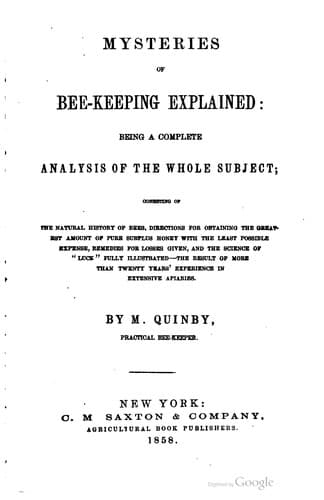
Mysteries of Bee-keeping ExplainedQuinby, M. (Moses)
Science
Mysteries of Bee-keeping Explained
Quinby, M. (Moses)
Bees
One stock in fifteen may commence piping, yet send out no swarm. The
bees will change their minds about coming out, and kill their queens,
or allow the eldest one of them to destroy the others, or some other
way, as they do not always swarm in such circumstances. But when the
piping continues over twenty-four hours, I never knew _but one
failure_! I have known a few (two or three) to commence this piping,
while I supposed the old queen was yet present, and had not left the
hive, on account of bad weather, but a swarm issued soon after. Also,
three instances where I supposed the old queen lost, from some other
cause than leading out a swarm, and the stock reared some young ones to
supply her place. It occurred in or near the swarming season, and one
or two issues was the consequence. One case was three weeks in advance
of the season, and the swarm was about half the usual size. When a
swarm has been out, and returned at the last of the swarming season, it
is much more probable to re-issue, than if it depended on an old queen
for a leader, that had not been out. Such will sometimes be a week or
ten days later than others. Once I had the first swarm kept back by wet
weather, and the second came out on the fifth day after; several other
instances on the seventh and eighth; and one as late as the sixteenth,
after the first.
A RULE FOR THE TIME OF THESE ISSUES.
This may be put down as a rule, that all after swarms _must_ be out by
the eighteenth day from the first. I never found an exception, unless
the following may be considered so: When a swarm left the middle of
May, and another the first of July, seven weeks after, but two cases of
this kind have come up, and these I consider rather in the light of
first swarms, as they leave under the same circumstances, leaving the
combs in the old stock filled with brood, queen-cells finished, &c. A
stock may cast swarms in June, and a buckwheat swarm in August, on the
same principle.
WHEN IT IS USELESS TO EXPECT MORE SWARMS.
Therefore, bee-keepers having but few stocks, will find it unnecessary
to watch their bees when the last of the first swarms came out sixteen
or eighteen days before. Much trouble may be thus saved by
understanding this matter. During my early days in beekeeping, I wished
for the greatest possible increase of stocks. I had some that had cast
the first swarm, and soon after clustered out again. I vainly watched
them for weeks and months, expecting another swarm. But had I
understood the _modus operandi_, as the reader may now understand it, I
should have been through with all my anxiety, as well as watching, in a
fortnight. As it was, it lasted two months. I found no one to give me
any light on this subject, or even tell me when the swarming season was
over, and I came very near watching all summer!
PLURALITY OF QUEENS DESTROYED.
Public-domain text, read in full here on John Shaqi.
Reviews
Reviews
No reviews yet
Be the first to share your thoughts on this work.
Elsewhere in the archive
Join the Discussion
Join the discussion
Sign in to leave a comment or review.
Sign InorCreate an account