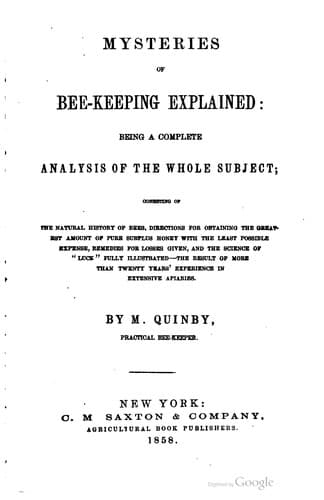
Mysteries of Bee-keeping ExplainedQuinby, M. (Moses)
Science
Mysteries of Bee-keeping Explained
Quinby, M. (Moses)
Bees
These after swarms are not very particular about the weather; heavy
winds, a few clouds, and sometimes a slight sprinkling of rain, will
not _always_ deter them. Neither are they very precise about the time
of day. I have known them in a warm morning to issue before seven
o'clock, and after five P.M. These things should be understood;
because, when after swarms are expected (of which the piping will give
warning), it is necessary to watch them in weather, and at times when
first ones would not venture to leave.
SWARMS NECESSARY TO BE SEEN.
It is essential that you see them, that you may know where they
cluster, otherwise it might be difficult to find them. They are apt to
go farther from the parent stock than others; sometimes fifty rods, and
then settle in two places, perhaps that distance apart, in some high or
inconvenient place to get at. (Let me not be misunderstood: I do not
say they all do so, or even the majority; but I wish to say that a
greater portion of these swarms do so than of the first.) If they
cluster in two places, a queen may be in each, and they will remain,
and when you have hived one part you may think you have all. If one
cluster is without a queen, they will join the other if near; but when
distant, will be very likely to return to the old stock soon, unless
put together. I had a swarm light in two places, in exactly opposite
directions from the stock. In one, a good swarm had clustered; in the
other, some less than a pint. The small part had one or more queens,
the other none. It was perceived at once by their movements. Now, if we
provide a hive for a swarm, and get a few to set up the call or
buzzing, they will not leave till that is stopped. There is generally
no difficulty to start it. The surest way is to jar a portion or all
directly into the hive. It takes a few minutes to get composed, and
miss the queen. In my case I got them in the hive, and before they
missed the queen, carried them to the small cluster, which I got in a
dipper and emptied in front of the hive; they entered, and all were
peaceable. You will therefore see the necessity of watching such
swarms, to see if there is no separation, if nothing else.
RETURNING AFTER SWARMS TO THE OLD STOCK.
Much has been said about returning all after swarms to the old stock;
the advantages of which will depend on the time of issuing; whether
late or early, the yield of honey, etc. It would be unusual to have
many after swarms without a liberal yield of honey, for the time being;
but to tell of its continuance is the question to be answered. Second,
and even third swarms, if early in the season, and the honey continues
plentiful, may be hived, and these, together with the old stock, will
prosper. Here the apiarian needs a little judgment and experience to
guide him.
WHEN THEY SHOULD BE RETURNED.
Public-domain text, read in full here on John Shaqi.
Reviews
Reviews
No reviews yet
Be the first to share your thoughts on this work.
Elsewhere in the archive
Join the Discussion
Join the discussion
Sign in to leave a comment or review.
Sign InorCreate an account