Mysteries of Bee-keeping ExplainedQuinby, M. (Moses)
Science
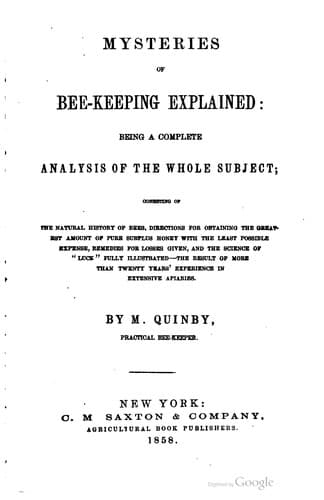
Mysteries of Bee-keeping Explained
Quinby, M. (Moses)
Bees
Occasionally a queen is lost at other than the swarming season,
averaging about one in forty. It is most frequent in spring; at least
it is generally discovered then. The queen may die in the winter, and
the bees not give us any indications till they come out in spring.
(Occasionally they may all desert the hive, and join another.) If we
expect to ascertain when a queen is lost at this season, we must notice
them just before dark on the first warm days--because the mornings are
apt to be too cool for any bees to be outside--any unusual stir, or
commotion, similar to what has been described, shows the loss. This is
the worst time in the year to provide the remedy, unless there should
happen to be some very poor stock containing a queen, that we might
lose any way--then it might be advisable to sacrifice it to save the
other, especially if the last contained all the requisites of a good
stock except a queen. Some eight or ten, that I have managed in this
way, have given me full satisfaction. I have at other times let them go
till the swarming season, and then procured a queen, or introduced a
small swarm; at which time they are so reduced as to be worth but
little, even when not affected by the worms. To obviate this loss in
this way, it might be an advantage to transfer the bees to the next
stock, if it was not too full already; or the bees of the next stock to
this. Let the age and condition of the combs, quantity of stores, &c.,
decide.
CHAPTER XV.
ARTIFICIAL SWARMS.
PRINCIPLES SHOULD BE UNDERSTOOD.
Artificial swarms can be made with safety at the proper season. To the
bee-keeper who wishes to increase his stocks, it will be an advantage
to understand some of the principles. I have had some little experience
that has led to different conclusions from those of some others. I have
seen it stated, and found the assertion repeated by nearly every
writer, that "whenever bees were deprived of their queen, if they only
possessed eggs or young larvæ, they would not fail to rear another,"
&c. There are numerous instances of their doing this, but it is not to
be depended upon, especially when left in a hive full of combs, as the
following experiments tend to prove.
SOME EXPERIMENTS.
Public-domain text, read in full here on John Shaqi.
Reviews
Reviews
No reviews yet
Be the first to share your thoughts on this work.
Elsewhere in the archive
Join the Discussion
Join the discussion
Sign in to leave a comment or review.
Sign InorCreate an account