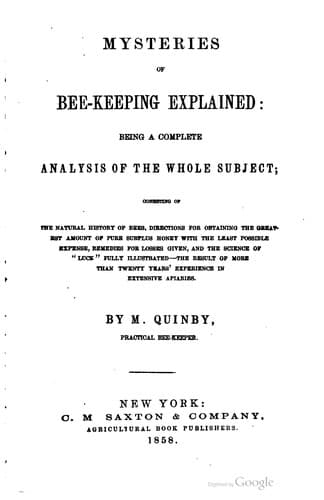
Mysteries of Bee-keeping ExplainedQuinby, M. (Moses)
Science
Mysteries of Bee-keeping Explained
Quinby, M. (Moses)
Bees
The greatest distance that I ever knew bees to go, and plunder a
defenceless stock of its contents, was three-fourths of a mile. Very
likely they would go farther on some occasions, but not often.
ACCUSATIONS NOT ALWAYS RIGHT.
Careless bee-keepers, when their hives are thus robbed, feel regret, or
are more often vexed at somebody--at the result of their carelessness.
The person, keeping most bees in a neighborhood, must expect to be
accountable for all effects of their ignorance, mismanagement, or
carelessness, and consequent "bad luck;" when all the honey thus
obtained, probably carries with it more mischief than can be eradicated
in a twelvemonth, thereby giving the real cause of complaint to the
other party.
CHAPTER XVIII.
IRRITABILITY OF BEES.
Keeping bees good-natured, offers a pretty fair subject for ridicule:
it seems rather too absurd to teach _a bee_ anything! Nevertheless, it
is worth while to think of it a little. Most of us know that by
injudicious training, horses, cattle, dogs, &c., may be rendered
extremely vicious. If there is no perceptible analogy between these and
bees, experience proves that they may be made ten times more irritable
than they naturally would be.
THEIR MEANS OF DEFENCE.
Nature has armed them with means to defend their stores, and provided
them with combativeness sufficient to use them when necessary. This
could not be bettered. If they were powerless to repel an enemy, there
are a thousand lazy depredators, man not excepted, who would prey upon
the fruits of their industry, leaving them to starve. Had it been so
arranged, this industrious insect would probably have long since been
extinct.
TIME OF GREATEST IRRITABILITY.
The season of their greatest caution, in this section, is August,
during the flowers of buckwheat. It is then their stores are greatest.
As soon as a stock is pretty well supplied with this world's goods,
like some bipeds, they become very haughty, proud, aristocratic, and
insolent. A great many things are construed into insults, that in their
days of adversity would pass unnoticed; but now it is becoming and
proper for their honor to show a "just resentment." It behooves us,
therefore, to ascertain what are considered insults.
PROPER CONDUCT.
First, all quick motions, such as running, striking, &c., about them,
are noticed. If our movements among them are slow, cautious, humble,
and respectful, we are often let to pass unmolested, having manifested
a becoming deportment. Yet the exhalations from some persons appear
very offensive, as they attack them much sooner than others; though I
apprehend there is not so great a difference as many suppose. Whenever
an attack is made, and a sting follows, the venom thus imparted to the
air, if by only one, is perceived by others at some distance, which
will immediately approach the scene, and more stings are likely to
follow than if the first had not been.
HOW TO PROCEED WHEN ATTACKED.
Public-domain text, read in full here on John Shaqi.
Reviews
Reviews
No reviews yet
Be the first to share your thoughts on this work.
Elsewhere in the archive
Join the Discussion
Join the discussion
Sign in to leave a comment or review.
Sign InorCreate an account