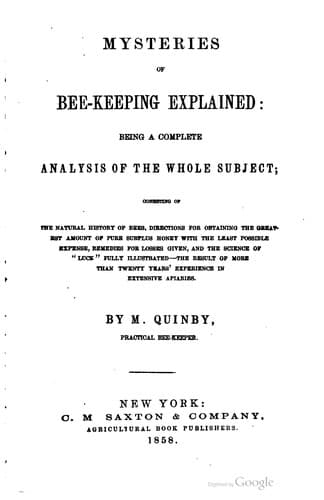
Mysteries of Bee-keeping ExplainedQuinby, M. (Moses)
Science
Mysteries of Bee-keeping Explained
Quinby, M. (Moses)
Bees
devour every drone, the moment it touched the board, while the workers
would pass by him in scores untouched!
Now, whether this taking the drones is a disadvantage or otherwise,
would depend entirely upon circumstances. If honey was a little scarce,
the less we had of them the better; it would also save the bees some
trouble in dispatching them. It is probably a matter of so little
moment to our bees, that it will not pay for powder to shoot them.
Martins, and a kind of swallows, are said to be guilty of taking bees
on some occasions; but as they pursue them on the wing (if they do),
the same remarks will apply as to the king-bird.
CAT-BIRD ACQUITTED.
The cat-bird also comes in for a share of censure. It is said "they
will get right down by the hive, and pick up bees by the hundred." Yet,
right in the face of this charge, I am disposed to acquit him. With the
closest observation, I find him about the hive, picking up _only_ young
and immature bees, such as are removed from the combs and thrown out.
They may be seen as soon as the first rays of light make objects
visible about the apiary, looking for their morning supply, as well as
frequent visits during the day. Should an unlucky worm be in sight just
then, while looking up a place for spinning a cocoon, or a moth
reposing on some corner of the hive, their fate is at once decided.
Before destroying this bird, it would be well to judge by actual
observation as to facts; otherwise we might "destroy a friend instead
of a foe."
TOAD GOT CLEAR.
A toad is discovered near the hives, and forthwith he is executed as a
bee-eater. "He ought to be killed for his looks, if nothing else!" He
is thus often sacrificed _really_ on account of his appearance, while
pretending he is a villain. It is true his "feathers" will not vie in
brilliancy with the plumage of the humming-bird, and do not gratify
ideality--therefore he is dispatched. The next week the complaint is
made that the little bugs, that he might have destroyed, "have eaten up
all the little cucumbers and cabbages." His food is probably small
insects. Whoever has seen him swallow bees, must have watched closer
than I ever did.
WASPS AND HORNETS NOT FAVORED.
As for the frequent visits of the black-wasp in the sunny days of
spring, but little can be said in their favor--they seem to have no
other object but to tease and irritate the bees. I never could discover
that they entered the hive for the purpose of plunder. They have
frequent battles with the bees, but I never saw any bees devoured or
carried off, nor even killed. After the first of June they are seldom
troublesome. The yellow wasp or hornet, that is around in autumn, is of
but little account; their object is honey, which they take when they
can get it, but are not apt to enter the hive among the bees.
ANTS--A WORD IN THEIR FAVOR.
Public-domain text, read in full here on John Shaqi.
Reviews
Reviews
No reviews yet
Be the first to share your thoughts on this work.
Elsewhere in the archive
Join the Discussion
Join the discussion
Sign in to leave a comment or review.
Sign InorCreate an account