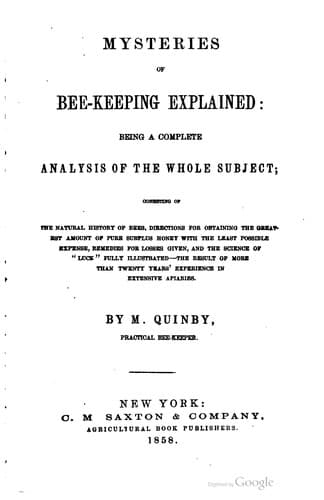
Mysteries of Bee-keeping ExplainedQuinby, M. (Moses)
Science
Mysteries of Bee-keeping Explained
Quinby, M. (Moses)
Bees
But it is altogether a different thing with our hives in which bees are
wintered; they are seldom or never entirely exempt! Perhaps it is
impossible to winter bees without preserving some eggs of the moth or a
few worms at the same time. The perfect moth perhaps never survives the
winter; the only place that the chrysalis would be safe, I think must
be in the vicinity of the bees--and a good stock will never allow it
there--but eggs, it would appear, are suffered to remain. In the fall,
at the approach of cold weather, the bees are apt to leave the ends of
the combs exposed; the moth can now enter and deposit her eggs directly
upon them; these, together with what are carried in by means before
suggested, are enough to prevent losing the breed. The warmth generated
by the bees will keep these eggs from freezing and preserve their
vitality. When warm weather approaches in the spring, those nearest the
bees are probably hatched first, and commence depredations and are
removed by the bees. As the bees increase and occupy more comb, more
are warmed up and hatched. In this way, even a small family of bees
will hatch, and get rid of all the eggs that happen to be in their
combs, and not be destroyed. This is the time that the apiarian may be
of service in destroying the worms, as the bees get them on the floor.
STOCKS MORE LIABLE TO BE DESTROYED LAST OF SUMMER.
But in July and August it is different in this respect; a single moth
may enter the hive when exposed, and deposit her whole burden of
several hundred eggs, as in the other case, but the heat from the bees
is now unnecessary to hatch them. The weather at this season will make
any part of the hive warm enough to set her whole brood at work at
once, and in three weeks all may be destroyed! This, and the fact that
more moths exist now than before, may account for the greater number of
stocks being destroyed at this season. Yet it is considered extremely
bad management to allow honey or combs to be devoured by this
disgusting creature. A little care to know the condition of the stocks
_is necessary_ to prevent their getting the start. These duties should
be fully considered before we take the responsibility of the care of
bees.
WHEN BEES ARE SAFE.
The only condition when we can rest and feel safe is when _we know all
our stocks are full of bees_. Even the "moth-proof" hive containing
combs will be scented out by the moth, when there are no bees to guard
it. An argument to show that a moth can enter where a bee can go is
unnecessary, and a little observation, I think, will prove that her
eggs sometimes go where she is not allowed.
MEANS TO DESTROY THEM.
Public-domain text, read in full here on John Shaqi.
Reviews
Reviews
No reviews yet
Be the first to share your thoughts on this work.
Elsewhere in the archive
Join the Discussion
Join the discussion
Sign in to leave a comment or review.
Sign InorCreate an account