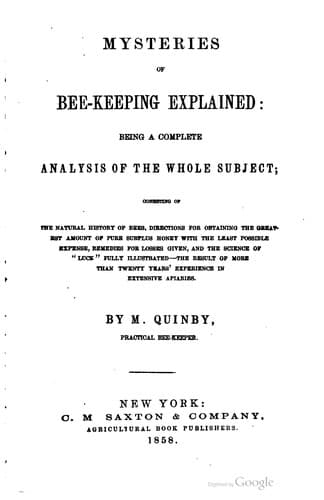
Mysteries of Bee-keeping ExplainedQuinby, M. (Moses)
Science
Mysteries of Bee-keeping Explained
Quinby, M. (Moses)
Bees
The latter part of the summer of 1851 was very dry and cold; the yield
of buckwheat honey was not a tenth of the usual quantity; the
consequence was, that none but early swarms had sufficient honey for
winter; twenty-five pounds is required to make it _safe_ in this
section. I had over thirty young swarms with less than that quantity.
Feeding for winter I avoid when I can; they would not winter as they
were; and yet I made the most of them good stocks for the next summer
by the following plan.
HOW THEY WERE MANAGED.
I had about twenty old stocks with diseased brood, and but few bees,
yet _honey enough_. Now this honey appears healthy enough for the old
bees, and fatal only to the young brood.
I transferred the bees of these new swarms to the old stocks with black
comb and diseased brood. The bees were thus wintered on honey of but
little account any way, and all that was in the others, new and
healthy, was saved. These new hives were set in a cold dry place for
winter; _right end up_, to prevent much of the honey from dripping out
of the cells; some will leak then, but not as much as when the hive is
bottom up. Honey that runs out, when the hive is bottom up, will soak
into the wood at the base of the combs; this will have a tendency to
loosen the fastenings, and render them liable to fall, &c.
The next March the bees were again transferred from the old to the new
hives. My method is as follows: As the combs in the hive to receive the
bees are rather cold, I set them by the fire, or in a warm room, for
several hours previous. I take a warm room before a window, and as some
few bees fly off, they will collect there. The new hive is turned
bottom up on the floor; the old one on a bench by the side of it,
having smoked the bees to keep them quiet. One comb at a time is taken
out, and the bees brushed into the new hive; (a little smoke will keep
them there). When through, I get the few on the window, and tie over a
cloth to confine them, and keep them warm for a few hours longer.
Paralyzing with puff-ball will answer instead, but they do not always
all fall out of the combs when the hive is filled to the bottom, and it
is possible that if a few were left, the queen might be one. Also a
very few bees are worth saving at this season, and the combs might have
to be broken out at last, for this purpose.
When a good-sized family is put in a hive containing fifteen or twenty
pounds of honey, and near half full of clean new comb, they are about
as sure to fill up and cast a swarm, as another that is full and has
wintered a swarm.
CAUSE OF THEIR SUPERIOR THRIFT.
One cause of superior thrift may be found in the circumstance, that all
moth eggs and worms are frozen to death, and the bees are not troubled
with a single worm before June. No young bees have to be removed to
work them out. Nearly every young bee that is fed and sealed up, comes
forth perfect, and of course makes a vast difference in the increase.
Public-domain text, read in full here on John Shaqi.
Reviews
Reviews
No reviews yet
Be the first to share your thoughts on this work.
Elsewhere in the archive
Join the Discussion
Join the discussion
Sign in to leave a comment or review.
Sign InorCreate an account