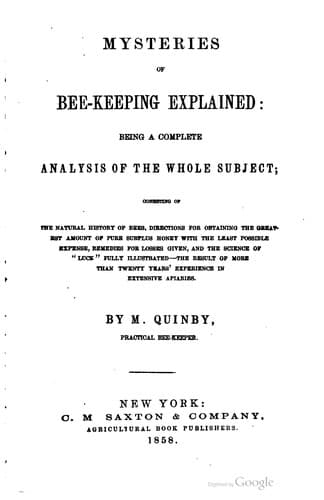
Mysteries of Bee-keeping ExplainedQuinby, M. (Moses)
Science
Mysteries of Bee-keeping Explained
Quinby, M. (Moses)
Bees
This accumulation of fæces is considered by many writers as a
disease--a kind of dysentery. It is described as affecting them towards
spring, and several remedies are given. Now if what I have been
describing is not the dysentery, why I must think I never had a case of
it; but I shall still persist in guessing it to be the same, and
suppose that inattention with many must be the reason that it is not
discovered in cold weather, at the time that it takes place. Some
stocks may be badly affected, yet not lost entirely, when moderate
weather will stop its progress. When a remedy is applied in the spring,
long after the cause ceases to operate, it would be singular if it was
not effectual. I have no doubt but some have taken the natural
discharge of fæces, that always takes place in spring when the bees
leave the hive, for a disease. Others, when looking for a cause for
diseased brood, and found the combs and hive somewhat besmeared, have
assigned this as sufficient; but according to my view, have reversed
it, giving the effect before the cause.
THE AUTHOR'S REMEDY.
For a time, I supposed that this moisture on the combs gradually mixed
with the honey, making it thin, and that the bees eating so much water
with their food, would affect them as described. Some experiments that
followed, induced me to assign cold as the cause, as I always found,
when I put them where it was sufficiently warm, that an immediate cure
was the result, or at least, it enabled them to retain their fæces till
set out in the spring.
BURYING BEES.
Burying bees in the earth below the frost, has been recommended as a
superior method of wintering, for small families. I have known it
confidently asserted, that they would lose nothing in weight, and no
bees would die. I found, in testing it, that a medium quantity of honey
sufficed, and but very few were lost, perhaps less than by any other
method. Yet the combs were mouldy, and unfit for further use. There was
no escape for the vapor and dampness of the earth. This did not satisfy
me; it only cured "one disease by instituting another." I saved the
bees, (and perhaps some honey), but the combs were spoiled.
EXPERIMENTS OF THE AUTHOR TO GET RID OF THE FROST.
I wished to keep them warm, and save the bees as well as honey, and at
the same time, get rid of the moisture. I found that a large family
expelled it much better than small ones; and if all were put together
in a close room, the animal heat from a large number combined, would be
an advantage to the weak ones, at least,--this proved of some benefit.
Yet I found on the sides of a glass hive, that large drops of water
would stand for weeks.
SUCCESS IN THIS MATTER.
The following suggestion then came to my relief. If this hive was
bottom up, what would prevent all this vapor as it arises from the bees
from passing off? (It always rises when warm, if permitted.) The hive
was inverted; in a few hours the glass was dry.
Public-domain text, read in full here on John Shaqi.
Reviews
Reviews
No reviews yet
Be the first to share your thoughts on this work.
Elsewhere in the archive
Join the Discussion
Join the discussion
Sign in to leave a comment or review.
Sign InorCreate an account