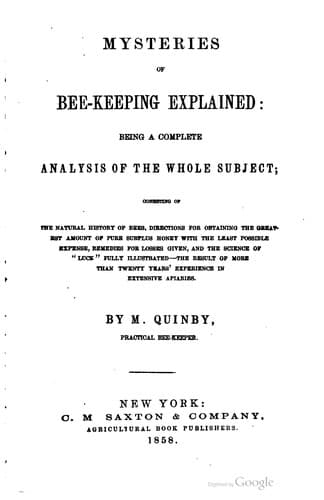
Mysteries of Bee-keeping ExplainedQuinby, M. (Moses)
Science
Mysteries of Bee-keeping Explained
Quinby, M. (Moses)
Bees
For this purpose, a wide board should be set up before the hive to
protect it from the sun, at least above the entrance in the side. But
if it grows sufficiently warm so that bees leave the hive when so
shaded, it is a fair test by which to tell when it will do to let them
have a good chance to sally out freely, except in cases of a new snow,
when it is advisable to confine them to the hive. The hive might be let
down on the floor-board, and the wire-cloth cover the passage in the
side, and made dark for the present; raising the hive at night again,
as before. I have known hundreds of stocks wintered successfully
without any such care being taken, and the bees allowed to come out
whenever they chose to do so. Their subsequent health and prosperity
proving that it is not altogether ruinous. It has been recommended to
enclose the whole hive by a large box set over it, and made perfectly
dark, with means for ventilation, &c. (A snow-bank would answer equally
well, if not better.) For large families it would do well enough, as
would also other methods. But I would much rather take the chances of
letting them all stand in the sun, and issue as they please, than to
have the warmth of the sun entirely excluded from the moderate-sized
families. I never knew a whole stock lost by this cause alone.[20] Yet,
I have known a great many starved, merely because the sun was not
allowed to melt the frost on the combs, and give them a chance to get
at their stores.
[20] Vide other causes of loss, a few pages back.
DO THE BEES EAT MORE WHEN ALLOWED TO COME OUT OCCASIONALLY IN WINTER?
Besides the loss of bees on the snow when standing in the sun, and
taking an airing occasionally, there are some economical bee-keepers
who urge this disadvantage, "that every time bees come out in winter
they discharge their excrement, and eat more honey in consequence of
the vacant room." What a ridiculous absurdity it would be to apply this
principle to the horse, whose health, strength, and vital heat is
sustained by the assimilation of food! and the farmer is not to be
found who would think of saving his provender by the same means. That
bees are supported in cold weather on the same principle is indicated
strongly, if not conclusively.
Is it not better (if what has been said on the subject of wintering
bees is correct) to keep our bees warm and comfortable when
practicable, as a means of saving honey?
To winter bees in the best manner, considerable care is required.
Whenever you are disposed to neglect them, you should bear in mind that
one early swarm is worth two late ones; their condition in spring will
often decide this point. Like a team of cattle or horses when well
wintered, they are ready for a good season's work, but when poorly
wintered have to recruit a long time before they are worth much.
CHAPTER XXIII.
SAGACITY OF BEES.
ARE NOT BEES DIRECTED ALONE BY INSTINCT?
Public-domain text, read in full here on John Shaqi.
Reviews
Reviews
No reviews yet
Be the first to share your thoughts on this work.
Elsewhere in the archive
Join the Discussion
Join the discussion
Sign in to leave a comment or review.
Sign InorCreate an account