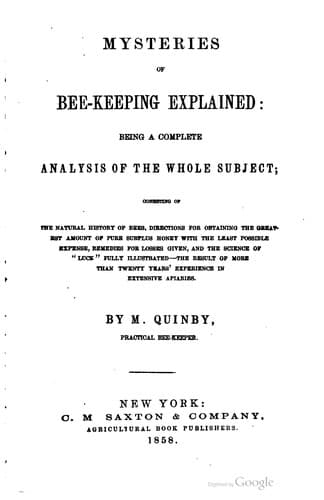
Mysteries of Bee-keeping ExplainedQuinby, M. (Moses)
Science
Mysteries of Bee-keeping Explained
Quinby, M. (Moses)
Bees
fraternal affection in regarding the mother's every want, and assiduous
care in nursing her offspring to maturity--their unaccountable display
of instinct in emergencies or accidents, filling the beholder with
wonder and amazement? The mind thus contemplating such astonishing
operations, cannot well avoid looking beyond these results to their
divine Author. Therefore let every mind that perceives one ray of light
from nature's mysterious transactions, and is capable of receiving the
least enjoyment therefrom, pursue the path still inviting onward in the
pursuit. Every new acquisition will bring an additional satisfaction,
and assist in the next attempt, which will be commenced with a renewed
and constantly increasing zest; and will arise from the contemplation a
wiser, better, and a nobler being, far superior to those who have never
soared beyond the gratifications of the mere animal, grovelling in the
dark. Is there, in the whole circle of nature's exhaustless storehouse,
any one science more inviting than this? What more exalting and
refining, and at the same time making a return in profits as a
pecuniary reward?
What would be the result in the aggregate of all the honey produced in
the flowers of the United States annually? Suppose we estimate the
productions of one acre to be one pound of honey, which is but a small
part of the real product in most places; yet, as a great many acres are
covered with water and forest,[22] this estimate is probably enough for
the average. This State (New York) contains 47,000 square miles; 640
acres in a square mile will multiply into a little more than
30,000,000, and each acre producing its pound of honey, we have the
grand result of 30,000,000 lbs. of honey. If we add the States of
Pennsylvania, Ohio and Michigan, we have an amount of over 126,000,000
lbs. What it might be by including all the States, those disposed may
ascertain. Enough for our purpose is made clear, and that is, a small
item only of an enormous amount is now secured.
[22] It should not be forgotten that forest trees are valuable,
especially when there is basswood, or even maple.
* * * * *
BOOKS PUBLISHED BY
J. M. SAXTON, AGRICULTURAL BOOK PUBLISHER,
152 FULTON STREET, NEW YORK,
Suitable for
School, Town, Agricultural and Private Libraries.
* * *
FOR SALE BY
A. S. BARNES & CO.,
Corner of Dutch and John-streets,
NEW YORK.
* * *
The American Farm Book;
The American Farm Book; or, a Compend of American Agriculture,
being a Practical Treatise on Soils, Manures, Draining, Irrigation,
Grasses, Grain, Roots, Fruits, Cotton, Tobacco, Sugar-Cane, Rice,
and every staple product of the United States; with the best
methods of Planting, Cultivating, and Preparation for Market.
Illustrated by more than 100 engravings. By R. L. Allen.
Public-domain text, read in full here on John Shaqi.
Reviews
Reviews
No reviews yet
Be the first to share your thoughts on this work.
Elsewhere in the archive
Join the Discussion
Join the discussion
Sign in to leave a comment or review.
Sign InorCreate an account