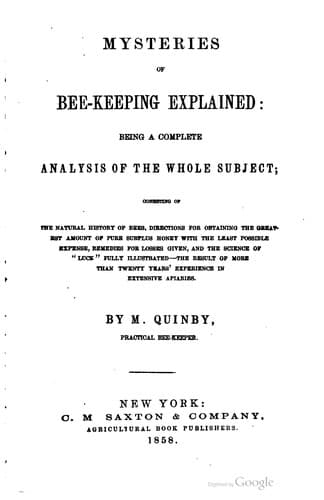
Mysteries of Bee-keeping ExplainedQuinby, M. (Moses)
Science
Mysteries of Bee-keeping Explained
Quinby, M. (Moses)
Bees
I have a few times found a humble-bee under the hive, that had entered,
and not finding his way out readily, was speedily shorn of his
beautiful "locks," and consequently his strength--that is, every
particle of hair, down, feathers, bristles, or whatever he had been
covered with, was completely removed by the bees, who had no regard for
his beautiful alternating stripes of yellow and brown; which left him
the very picture of darkness.
CHAPTER IV.
BEE PASTURAGE.
In some seasons the earth is covered with snow much later than others.
When this occurs, a greater number of warm days are necessary to melt
it, and start the flowers, than otherwise.
SUBSTITUTE FOR POLLEN.
During these warm days, while waiting for the flowers, the bees are
anxious to do something. It is then interesting to watch them, and see
what will be used as substitutes for pollen and honey. At such times, I
have seen hundreds engaged on a heap of sawdust, gathering the minute
particles into little pellets on their legs, seeming quite pleased with
the acquisition. Rotten wood, when crumbled into powder, and dry, is
also collected. Flour, when scattered near the hive, I have known to be
taken up in considerable quantities. Some apiarians have fed it to
their bees at this season, and consider it a great advantage; I have
not tested it sufficient to give an opinion. A substitute for honey is
sap from a few kinds of trees, yet it all amounts to but very little.
All these unnatural sources are abandoned when the flowers appear.
MANNER OF PACKING IT.
The particular manner of obtaining pollen has been witnessed by but
very few persons, as it is generally brushed from their bodies and
packed on their legs, while on the wing, thereby preventing a fair
chance to inspect operations. When collecting only pollen they alight
on the flowers, passing rapidly over the stamens, detaching a portion
of the dust, which lodges on most parts of them, to be brushed together
and packed into pellets when again on the wing. Thus they keep
alternately flying and alighting until a load is obtained, when they
immediately return to the hive; each bee bringing several loads in a
day. Honey, as it is collected, is deposited in the abdomen, and kept
out of sight till stored in the hive.
ALDER YIELDS THE FIRST.
The first material gathered from flowers is pollen. Candle-alder
(_Alnus Rubra_)[9] yields the first supply. The time of flowering
varies from the 10th of March to the 20th of April. The amount afforded
is also variable. Cold, freezing weather frequently destroys a great
portion of these flowers after they are out. These staminate flowers
are nearly perfected the season previous, and a few warm days in spring
will bring them out, even before any leaves appear. When the weather
continues fine, great quantities of farina are secured.
[9] The botanical names are from Wood's Class-Book.
Public-domain text, read in full here on John Shaqi.
Reviews
Reviews
No reviews yet
Be the first to share your thoughts on this work.
Join the Discussion
Join the discussion
Sign in to leave a comment or review.
Sign InorCreate an account