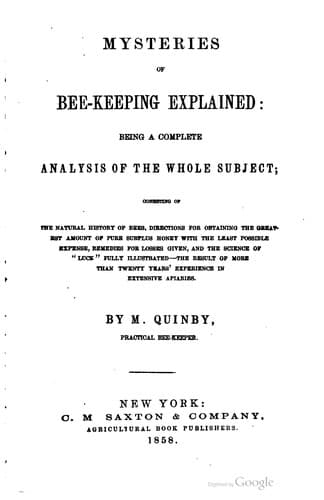
Mysteries of Bee-keeping ExplainedQuinby, M. (Moses)
Science
Mysteries of Bee-keeping Explained
Quinby, M. (Moses)
Bees
The time that bees commence their labors does not govern the time of
swarming by any means; this matter depends on the weather through April
and May. These remarks apply particularly to this section, Green
County, New York, in latitude about 42 degrees. In other places many
different trees, shrubs, and herbs, may be found yielding honey and
pollen that scarcely exist here, producing far different results.
Our swamps produce several varieties of willow, (salix,) that put out
their blossoms very irregularly. Some of these bushes are a month
earlier than others, and some of the buds on the same bush are a week
or two later than the rest. These also afford only pollen, but are much
more dependence than alder, as a turn of cold weather cannot at any
time destroy more than a small part. Next comes the aspen, (_Populus
Tremuloides_); of this we have more than is necessary for any purpose.
It is not a particular favorite with the bees, as but few,
comparatively, visit it. It is followed very soon by an abundance of
the red maple (_Acer Rubrum_), that suits them better, but this, like
the others, is often lost by freezing. The first honey obtained of any
account is from the golden willow (_Salix Vitellina_); it yields no
pollen, and is seldom injured by frost. Gooseberries, currants,
cherries, pear and peach trees, add a share of both honey and pollen.
Sugar maple (_Acer Saccharinum_) now throws out its ten thousand silken
tassels, beautiful as gold. Strawberries modestly open their petals in
invitation, but, like "obscure virtues," are often neglected for the
more conspicuous Dandelion, and the showy appearance and flagrant
blossoms of the apple-trees, which now open their stores, offering to
their acceptance a real harvest.
FRUIT FLOWERS IMPORTANT IN GOOD WEATHER.
In good weather, sometimes a gain of twenty lbs. is added to their
stores, during this period of apple-tree blossoms. But we are seldom
fortunate enough to have good weather all through this period, it being
rainy, cloudy, cool, or windy, which is very detrimental. Sometimes a
frost at this time destroys all, and the gain of our bees is reversed,
that is, they are lighter at the end than at the beginning of these
flowers. Yet this is the season that decides their prosperity for the
summer, whether they do _first rate_ or otherwise. If good weather now,
we expect our first swarms about the first of June; if not, no
subsequent yield of honey will make up for this deficiency. We now have
a time of several days, from ten to fourteen, in which but few flowers
exist. If our hives are poorly supplied when this scarcity occurs, it
will so disarrange their plans for swarming, that no preparations are
again made much before July, and sometimes not at all. In sections
where the wild cherry (_Cerasus Seratina_) abounds, the flowers of this
will appear and fill this time of scarcity, which this section annually
presents.
RED RASPBERRY A FAVORITE.
Public-domain text, read in full here on John Shaqi.
Reviews
Reviews
No reviews yet
Be the first to share your thoughts on this work.
Join the Discussion
Join the discussion
Sign in to leave a comment or review.
Sign InorCreate an account