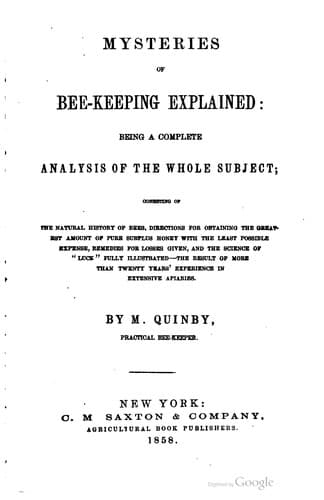
Mysteries of Bee-keeping ExplainedQuinby, M. (Moses)
Science
Mysteries of Bee-keeping Explained
Quinby, M. (Moses)
Bees
The red raspberry (_Rubus Strigosus_) next presents the stamens as the
most conspicuous part of the flower, soliciting the embrace of the bee,
by pouring out bounteous libations more prized by our industrious
insect than wine. For several weeks they are allowed to partake of this
exquisite beverage; it is secreted at all hours and in all kinds of
weather. When the morning is warm we often hear their cheerful humming
among the leaves and flowers of this shrub, ere the sun appears above
the horizon. The gentle shower, sufficient to induce man to seek a
shelter, is often unheeded by the bee when luxuriating among these
flowers; even white clover, important as it is in furnishing the
greatest part of their stores, at this season, would be neglected if
there was only a full supply of this. Clover begins to blossom with the
raspberry, and continues longer. We have an insufficient supply (in
this section) in most seasons. Red clover probably secretes as much
honey as the white, but the tube of the corolla being longer, the bee
appears to be unable to reach it. Yet I have seen a few at work even
here but it appeared like slow business. Sorrel, (_Rumex Acetosella_)
the pest of many farmers, is brought under contribution, and furnishes
the precious dust in any quantity. Morning is the only part of the day
appropriated to its collection.
CATNIP, MOTHER-WORT, AND HOARHOUND ARE SOUGHT AFTER.
Catnip, (_Nepeta Cataria_,) Mother-wort, (_Leonurus Cardiaca_,) and
Hoarhound, (_Marrubium Vulgare_,) about the middle of June, put forth
their flowers, rich in sweetness, and like the Raspberry, the bees
visit them at all hours and in nearly all kinds of weather. They last
from four to six weeks; the catnip I have known to last twelve in a few
instances, yielding honey during the whole time. Ox-eye daisy,
(_Leucanthemum Vulgare_,) that beautiful and splendid flower, in
pasture and meadow, and worth but little in either, also contains some
honey. The flower is compound, and each little floret contains
particles so minute, that the task of obtaining a load is very tedious.
It is only visited when the more copious honey-yielding flowers are
scarce. Snap-dragon,(_Linaria Vulgaris_,) with its nauseous and
sickening odor, troubling the farmer with its vile presence, is made to
bestow the only good thing about it, except its beauty, upon our
insect. The flower is large and tubular, and the bee to reach the honey
must enter it; to see the bee almost disappear within the folds of the
corolla, one would think that it was about being swallowed, when the
hideous mouth was gaping to receive it; but unharmed, soon it emerges
from the yellow prison, covered with dust; this is not brushed into
pellets on its legs, like the pollen from some other flowers, but a
part adheres to its back between the wings, which it is apparently
unable to remove, as it remains there sometimes for months, making a
cluster outside the hive, appear quite speckled. Bush honey-suckle
Public-domain text, read in full here on John Shaqi.
Reviews
Reviews
No reviews yet
Be the first to share your thoughts on this work.
Join the Discussion
Join the discussion
Sign in to leave a comment or review.
Sign InorCreate an account