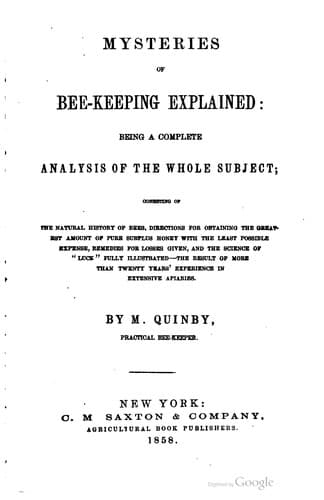
Mysteries of Bee-keeping ExplainedQuinby, M. (Moses)
Science
Mysteries of Bee-keeping Explained
Quinby, M. (Moses)
Bees
[10] In Wood's Class-book of Botany, "Order CII.," in a plate
showing the parts of this plant, it is thus described: "Fig. 11,
a pair of pollen masses suspended from the glands at an angle of
the antheridium," &c.
One, when reading this simple botanical description, and seeing
the plate, or the Botanist with his glasses, when he minutely
inspects the parts, would not suspect anything fatal to bees
about it.
Whitewood (_Liriodendron Tulipifera_) yields something eagerly sought
for by the bees, but whether honey, or pollen, or both, I have never
been able to ascertain. All the flowers of this kind, with us, are too
high. It is very scarce, as well as Basswood, (_Tilia Americana_,)--that
in some places is abundant, and yields honey clear and transparent as
water, superior in appearance, but inferior in flavor to clover; it
also appears much thinner when first collected.
LARGE YIELD FROM BASSWOOD.
During the time this tree is in bloom, a period of two or three weeks
in many sections, astonishing quantities are obtained. A person once
assured me that he had known "ten pounds collected by one swarm in a
day, by weighing the hive in the morning and again at evening." I have
some doubt of the statement, and think half the amount would be a good
day's work; but I had but a small chance to know, as only a few trees,
as a specimen, grow in this section. I have weighed hives during
seasons of apple-tree blossoms and buckwheat, the two best yields of
honey we have, and three and a half pounds was the best for one day
that I ever had. Sumach, (_Rhus Glabra_,) in some sections, affords
considerable honey. Mustard (_Sinapis Nigra_) is also a great favorite.
I have now mentioned most of the honey-producing trees and plants that
come on before the middle of July. The course of these flowers is
termed the first yield. In sections where there are no crops of
buckwheat, it constitutes the only full one. Other flowers continue to
bloom till cold weather. Where white clover is abundant and the fields
are used for pasture, it will continue to throw out fresh flowers,
sometimes, throughout the summer; yet the bees consume about all they
collect in rearing their brood, &c. Thus it appears in some sections
six or eight weeks is about all the time they have to provide for
winter.
GARDEN FLOWERS UNIMPORTANT.
In passing along I have not mentioned garden flowers, because the
amount obtained here is a small item, compared to the forest and
fields--especially ornamental flowers. It is true that the Hollyhock,
(_Altha Rosea_,) Mallows, (_Malva Rotundifolia_) and many others yield
honey, but what does it amount to? A person expecting his hives to be
filled from such a source would very likely be disappointed, especially
when many are kept together.
HONEY-DEW.
Public-domain text, read in full here on John Shaqi.
Reviews
Reviews
No reviews yet
Be the first to share your thoughts on this work.
Elsewhere in the archive
Join the Discussion
Join the discussion
Sign in to leave a comment or review.
Sign InorCreate an account