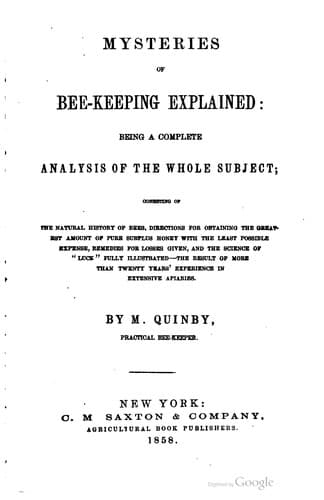
Mysteries of Bee-keeping ExplainedQuinby, M. (Moses)
Science
Mysteries of Bee-keeping Explained
Quinby, M. (Moses)
Bees
Honey-dew is said to be a source from whence large collections are made
in some places. When or where it appears or disappears is more than I
can tell. I have seen the accounts of it, but accounts I have learned
to doubt until I find something corroborative in my own experience. I
find too many errors copied merely because they happen to be in company
with several truths. Huber discovered many important truths, and has
given them to the world; too many writers take it for granted when two
points of his are true, the third _must be also_. It is no proof that
there is no such article merely because I never discovered it. In the
many fruitless endeavors that I have made to get a view of this
substance, it may be I have lacked close observation; or possibly there
is none showered upon this region; or I may have failed to bring my
imagination to assist me to convert common dew into the real article.
SINGULAR SECRETION.
I once discovered bees collecting a secretion unconnected with flowers;
but was not honey-dew, as it has been described. I was passing a bush
of Witch-hazel, (_Hamamelis Virginiana_,) and was arrested by an
unusual humming of bees. At first I supposed that a swarm was about me,
yet it was late in the season, (it being about the 25th July.) On close
inspection, I found the bush contained numerous warty excrescences, the
size and shape of a hickory-nut. These proved to be only a shell--the
inside lined with thousands of minute insects, a species of aphis.
These appeared to be engaged sucking the juices, and discharging a
clear, transparent fluid. Near the stem was an orifice about an eighth
of an inch in diameter, out of which this liquid would gradually exude.
So eager were the bees for this secretion, that several would crowd
around one orifice at a time, each endeavoring to thrust the other
away. This occurred several years ago, and I never have been able to
find anything like it since; neither have I learned whether it is
common in other sections.
SECRETIONS OF THE APHIS.
The liquid ejected by the aphis, (plant louse,) when feeding or sucking
the juices of tender leaves, and received by the ants that are always
in attendance, is something like it; but in this case the bees were in
attendance instead of ants.
This mode of elaborating honey, although not generally collected by
bees, perhaps may not be too much out of place here. Also, it may
furnish a clue to the cause or substantiate some theory of honey-dew.
Public-domain text, read in full here on John Shaqi.
Reviews
Reviews
No reviews yet
Be the first to share your thoughts on this work.
Elsewhere in the archive
Join the Discussion
Join the discussion
Sign in to leave a comment or review.
Sign InorCreate an account