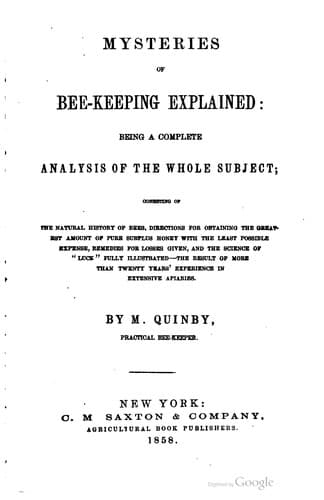
Mysteries of Bee-keeping ExplainedQuinby, M. (Moses)
Science
Mysteries of Bee-keeping Explained
Quinby, M. (Moses)
Bees
The careless, unreflecting observer, when seeing the bees enter the
hive with a pellet of pollen on each of their posterior legs, is very
apt to conclude that it must be material for comb, as it appears unlike
honey. So little regard is paid to the matter by many people, that they
are unable to imagine any other use for it. Others suppose that it will
change from that to honey, after being stored a time in the hive, and
wonder at the curious phenomenon; but when asked how long a time must
elapse before it takes place, they cannot tell exactly, but they "have
found cells where it began to change, as a portion near the outer end
of the cell had become honey, and no doubt the remainder would in
time." It has been remarked that cells were only filled about
two-thirds full of this, and finished with honey; now when any one
finds a cell filled to the brim with pollen, and no honey, such
reasoning will apply better. If this was the case, by examining at
different periods through the summer, we certainly should find some
cells before the change had commenced, instead of their always being in
just this stage of transition.
IS POLLEN CONVERTED INTO WAX?
As for pollen being converted into wax or comb, a simple question will
show its fallacy. Do not the bees belonging to a hive that is full of
combs, and no more wax for that purpose needed, bring home as much and
often more pollen than one half full? Any person who has watched two
such hives five minutes when busily engaged at work, can answer. It is
evident, then, that pollen is for something else besides wax.
HOW IS IT OBTAINED?
Public-domain text, read in full here on John Shaqi.
Reviews
Reviews
No reviews yet
Be the first to share your thoughts on this work.
Elsewhere in the archive
Join the Discussion
Join the discussion
Sign in to leave a comment or review.
Sign InorCreate an account