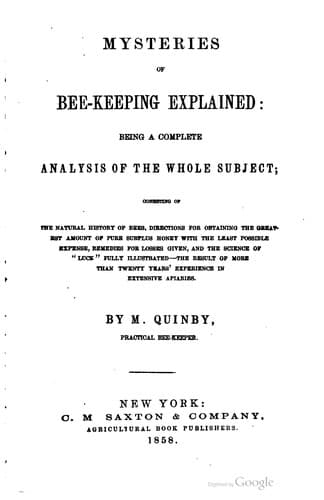
Mysteries of Bee-keeping ExplainedQuinby, M. (Moses)
Science
Mysteries of Bee-keeping Explained
Quinby, M. (Moses)
Bees
A large swarm will probably carry with them some five or six pounds of
honey from the parent stock. I only guess at this, because I am
uncertain what the bees weigh exactly. "I can tell you," some one
exclaims, "I saw some weighed,--so many weigh just eight ounces." Are
you sure there was nothing but bees weighed? Was there no honey,
bee-bread, fæces, or other substance, that might deceive you? "Can't
say; I never thought of that!" Now it is important, if we weigh bees to
know _their_ weight, to be sure we weigh nothing else. It is evident,
that if five thousand weigh three pounds, when nothing is in their
sacks, they would weigh, when filled with honey, several pounds more.
Hence, the fallacy of judging of the size of a swarm by weight, as one
swarm might issue with half the honey of another. Perhaps eight pounds,
for large swarms, might be an average for bees and honey. This honey,
whatever it amounts to, cannot be stored till combs are constructed to
hold it. This principle holds good till the hive is full. That is,
whenever they have more honey than the combs will hold, if there is
room in the hive, they construct more. But they seem to go no farther
than this in comb-making. However large the swarm may be, this
compulsion appears necessary to fill the hive. Drone-cells are seldom
made in the top of the hive, but a part are generally joined on the
worker-cells, a little distance from the top; others near the bottom.
There seems to be no rule about the number of such cells. Some hives
will contain twice the number of others. It may depend on the yield of
honey at the time; when very plenty, more drone-cells, &c. If the hive
be very large, no doubt an unprofitable number would be constructed.
Where the large and small cells join, there will be some cells of
irregular shape; some with four or five angles; the distance from one
angle to the other is also varied. Even where two combs of cells the
same size join, making a straight comb, they are not always perfect.
SOME WAX WASTED.
When constructing comb, they are constantly wasting wax, either
accidentally or voluntarily. The next morning after a swarm is located,
the scales may be found, and will continue to increase as long as they
are working it; the quantity often amounts to a handful or more. It is
the best test of comb-making that I can give. Clean off the board and
look the next morning, you will find the scales in proportion to their
progress. Some will be nearly round as at first; others more or less
worked up, and a part will be like fine saw-dust.
Huber and some others have divided the working bees into different
classes, denominating some wax-workers, others nurses, and pollen
gatherers, &c. It may be partially true, but how it was found out is
the mystery.
The angles in the cells used for brood, are gradually filled, and after
a time become round, both at the ends and sides.
WATER NECESSARY TO COMB-MAKING.
Public-domain text, read in full here on John Shaqi.
Reviews
Reviews
No reviews yet
Be the first to share your thoughts on this work.
Elsewhere in the archive
Join the Discussion
Join the discussion
Sign in to leave a comment or review.
Sign InorCreate an account