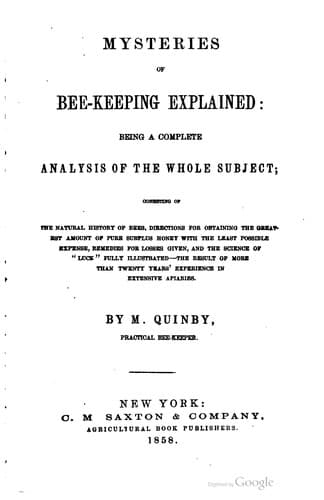
Mysteries of Bee-keeping ExplainedQuinby, M. (Moses)
Science
Mysteries of Bee-keeping Explained
Quinby, M. (Moses)
Bees
We will now notice the appearance about a weak hive that makes no
resistance, and show the result to be a total loss of the stock,
without timely interference. Each robber, when leaving the hive,
instead of flying in a direct line to its home, will turn its head
towards the hive to mark the spot, that it may know where to return for
another load, in the same manner that they do when leaving their hive
in the spring. The first time the young bees leave home, they mark
their location, by the same process. A few of these begin to hatch from
the cells very early; in all good stocks, often before the weather is
warm enough for _any to leave the hive_. Consequently, it cannot be too
early for them at any time in spring. These young bees, about the
middle of each fair day, or a little later, take a turn of flying out
very thickly for a short time. The inexperienced observer would be very
likely to suppose such stock very prosperous, from the number of
inhabitants in motion. This unusual bustle is the first indication of
foul play, and should be regarded with suspicion; yet it is not
conclusive.
A DUTY.
It is the duty of every bee-keeper, who expects to succeed, to know
which his weak stocks are; an examination some cool morning, can be
made by turning the hive bottom up, and letting the sun among the
combs. The number of inhabitants in them is easily seen. When weak,
close the entrance, till there is just room for one bee to pass at
once. The first real pleasant days, at any time before honey is
obtained plentifully, a little after noon, look out for them to
commence robbing. Whenever a weak stock is taken with what appears to
be a fit of unusual industry, it is quite certain they are either
robbers or young bees; the difficulty is to decide which. Their motions
are alike, but there is a little difference in color--the young bees
are a shade lighter; the abdomen of the robbers, when filled with
honey, is a little larger. It requires close, patient observation, to
decide this point, and when you have watched close enough to detect
this difference, you can decide without trouble.
A TEST.
But while you are learning this nice distinction, your bees may be
ruined. We will, therefore, give some other means of protection.
Public-domain text, read in full here on John Shaqi.
Reviews
Reviews
No reviews yet
Be the first to share your thoughts on this work.
Elsewhere in the archive
Join the Discussion
Join the discussion
Sign in to leave a comment or review.
Sign InorCreate an account