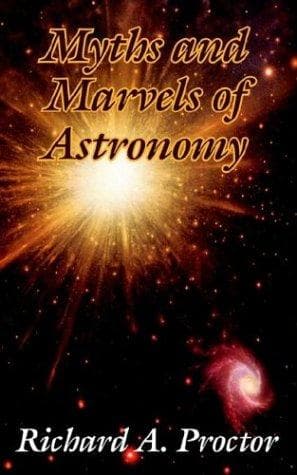
Myths and Marvels of AstronomyProctor, Richard A. (Richard Anthony)
History
Myths and Marvels of Astronomy
Proctor, Richard A. (Richard Anthony)
Astronomy
In the first place, we may dismiss as altogether unlikely the visit of a
comet from the star-depths to our sun, on a course carrying the comet
directly upon the sun's surface. But if, among the comets travelling in
regular attendance upon the sun, there be one whose orbit intersects the
sun's globe, then that comet must several times ere this have struck the
sun, raising him temporarily to a destructive degree of heat. Now, such
a comet must have a period of enormous length, for the races of animals
now existing upon the earth must all have been formed since that comet's
last visit--on the assumption, be it remembered, that the fall of a
large comet upon the sun, or rather the direct passage of the sun
through the meteoric nucleus of a large comet, would excite the sun to
destructive heat. If all living creatures on the earth are to be
destroyed when some comet belonging to the solar system makes its next
return to the sun, that same comet at its last visit must have raised
the sun to an equal, or even greater intensity of heat, so that either
no such races as at present exist had then come into being, or, if any
such existed, they must at that time have been utterly destroyed. We
may fairly believe that all comets of the destructive sort have been
eliminated. Judging from the evidence we have on the subject, the
process of the formation of the solar system was one which involved the
utilisation of cometic and meteoric matter; and it fortunately so
chanced that the comets likely otherwise to have been most
mischievous--those, namely, which crossed the track of planets, and
still more those whose paths intersected the globe of the sun--were
precisely those which would be earliest and most thoroughly used up in
this way.
Public-domain text, read in full here on John Shaqi.
Reviews
Reviews
No reviews yet
Be the first to share your thoughts on this work.
Elsewhere in the archive
Join the Discussion
Join the discussion
Sign in to leave a comment or review.
Sign InorCreate an account