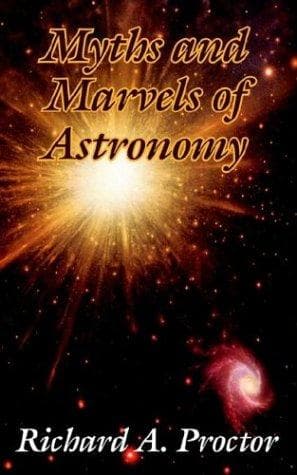
Myths and Marvels of AstronomyProctor, Richard A. (Richard Anthony)
History
Myths and Marvels of Astronomy
Proctor, Richard A. (Richard Anthony)
Astronomy
There remains only the theory that the Saturnian ring-system consists of
discrete masses analogous to the streams of meteors known to exist in
great numbers within the solar system. The masses may be solid or fluid,
may be strewn in relatively vacant space, or may be surrounded by
vaporous envelopes; but that they are discrete, each free to travel on
its own course, seemed as completely demonstrated by Pierce's
calculations as anything not actually admitting of direct observation
could possibly be. The matter was placed beyond dispute by the
independent analysis to which Clerk Maxwell subjected the mathematical
problem. It had been selected in 1855 as the subject for the Adams Prize
Essay at Cambridge, and Clerk Maxwell's essay, which obtained the prize,
showed conclusively that only a system of many small bodies, each free
to travel upon its course under the varying attractions to which it was
subjected by Saturn itself, and by the Saturnian satellites, could
possibly continue to girdle a planet as the rings of Saturn girdle him.
It is clear that all the peculiarities hitherto observed in the
Saturnian ring-system are explicable so soon as we regard that system as
made up of multitudes of small bodies. Varieties of brightness simply
indicate various degrees of condensation of these small satellites. Thus
the outer ring had long been observed to be less bright than the inner.
Of course it did not seem impossible that the outer ring might be made
of different materials; yet there was something bizarre in the
supposition that two rings forming the same system were thus different
in substance. It would not have been at all noteworthy if different
parts of the same ring differed in luminosity--in fact, it was much more
remarkable that each zone of the system seemed uniformly bright all
round. But that one zone should be of one tint, another of an entirely
different tint, was a strange circumstance so long as the only available
interpretation seemed to be that one zone was made (throughout) of one
substance, the other of another. If this was strange when the difference
between the inner and outer bright rings was alone considered, how much
stranger did it seem when the multitudinous divisions in the rings were
taken into account! Why should the ring-system, 30,000 miles in width,
be thus divided into zones of different material? An arrangement so
artificial is quite unlike all that is elsewhere seen among the
subjects of the astronomer's researches. But when the rings are regarded
as made up of multitudes of small bodies, we can quite readily
understand how the nearly circular movements of all of these, at
different rates, should result in the formation of rings of aggregation
and rings of segregation, appearing at the earth's distance as bright
rings and faint rings. The dark ring clearly corresponds in appearance
with a ring of thinly scattered satellites. Indeed, it seems impossible
Public-domain text, read in full here on John Shaqi.
Reviews
Reviews
No reviews yet
Be the first to share your thoughts on this work.
Elsewhere in the archive
Join the Discussion
Join the discussion
Sign in to leave a comment or review.
Sign InorCreate an account