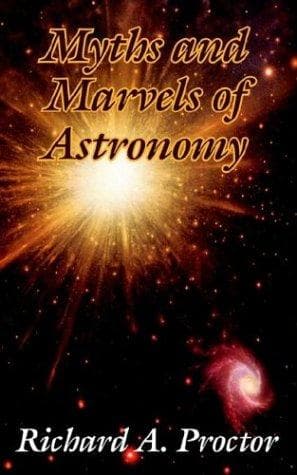
Myths and Marvels of AstronomyProctor, Richard A. (Richard Anthony)
History
Myths and Marvels of Astronomy
Proctor, Richard A. (Richard Anthony)
Astronomy
Yet, even
in our time, it is not possible to assert confidently that such fears
are idle. During the solar outburst witnessed by Carrington and Hodgson
in September 1859, it is supposed that the sun swallowed a large
meteoric mass; and, as great cornets are probably followed by many such
masses, it seems reasonable to infer that if such a comet fell upon the
sun, his surface being pelted with such exceptionally large masses,
stoned with these mighty meteoric balls, would glow all over (or nearly
so) as brightly as a small spot of that surface glowed upon that
occasion. Now that portion was so bright that Carrington thought 'that
by some chance a ray of light had penetrated a hole in the screen
attached to the object-glass by which the general image is thrown in
shade, for the brilliancy was fully equal to that of direct sunlight.'
Manifestly, if the whole surface of the sun, or any large portion of the
surface, were caused to glow with that exceeding brilliancy, surpassing
ordinary sunlight in the same degree that ordinary sunlight surpassed
the shaded solar image in Carrington's observations, the result would be
disastrous in the extreme for the inhabitants of that half of the earth
which chanced to be in sunlight at the time; and if (as could scarcely
fail to happen) the duration of that abnormal splendour were more than
half a day, then the whole earth would probably be depopulated by the
intense heat. The danger, as I have said, is slight--partly because
there is small chance of a collision between the sun and a comet, partly
because we have no certain reasons for assuming that a collision would
be followed by the heating of the sun for a while to a very high
temperature. Looking around at the suns which people space, and
considering their history, so far as it has been made known to us, for
the last two thousand years, we find small occasion for fear. Those suns
seem to have been for the most part safe from any sudden or rapid
accessions of heat; and if they travel thus safely in their mighty
journeys through space, we may well believe that our sun also is safe.
Nevertheless, there _have_ been catastrophes here and there. Now one sun
and now another has blazed out with a hundred times its usual lustre,
gradually losing its new fires and returning to its customary
brightness; but after what destruction among those peopling its system
of worlds who shall say? Spectroscopic analysis, that powerful help to
the modern astronomical inquirer, has shown in one of these cases that
just such changes had taken place as we might fairly expect would follow
if a mighty comet fell into the sun. If this interpretation be correct,
then we are not wholly safe. Any day might bring us news of a comet
sailing full upon our sun from out the depths of space. Then astronomers
would perhaps have the opportunity of ascertaining the harmlessness of a
collision between the ruler of our system and one of the long-tailed
visitors from the celestial spaces.
Public-domain text, read in full here on John Shaqi.
Reviews
Reviews
No reviews yet
Be the first to share your thoughts on this work.
Elsewhere in the archive
Join the Discussion
Join the discussion
Sign in to leave a comment or review.
Sign InorCreate an account