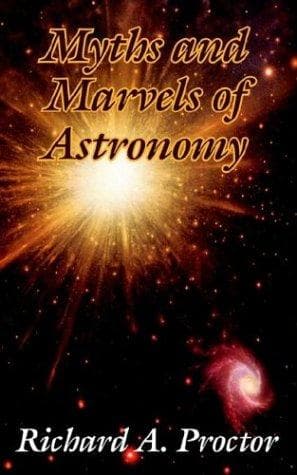
Myths and Marvels of AstronomyProctor, Richard A. (Richard Anthony)
History
Myths and Marvels of Astronomy
Proctor, Richard A. (Richard Anthony)
Astronomy
The expression 'astronomical myth' has recently been used, on the
title-page of a translation from the French, as synonymous with false
systems of astronomy. It is not, however, in that sense that I here use
it. The history of astronomy presents the records of some rather
perplexing observations, not confirmed by later researches, but yet not
easily to be explained away or accounted for. Such observations Humboldt
described as belonging to the myths of an uncritical period; and it is
in that sense that I employ the term 'astronomical myth' in this essay.
I propose briefly to describe and comment on some of the more
interesting of these observations, which, in whatever sense they are to
be interpreted, will be found to afford a useful lesson.
It is hardly necessary, perhaps, to point out that the cases which I
include here I regard as really cases in which astronomers have been
deceived by illusory observations. Other students of astronomy may
differ from me as respects some of these instances. I do not wish to
dogmatise, but simply to describe the facts as I see them, and the
impressions which I draw from them. Those who view the facts differently
will not, I think, have to complain that I have incorrectly described
them.
At the outset, let me point out that some observations which were for a
long time regarded as mythical have proved to be exact. For instance,
when as yet very few telescopes existed, and those very feeble,
Galileo's discovery of moons travelling round Jupiter was rejected as an
illusion for which Satan received the chief share of credit. There is an
amusing and yet in one aspect almost pathetic reference to this in his
account of his earlier observations of Saturn. He had seen the planet
apparently attended on either side by two smaller planets, as if helping
old Saturn along. But on December 4, 1612,[54] turning his telescope on
the planet, he found to his infinite amazement not a trace of the
companion planets could be seen; there in the field of view of his
telescope was the golden-tinted disc of the planet as smoothly rounded
as the disc of Mars or Jupiter. 'What,' he wrote, 'is to be said
concerning so strange a metamorphosis? Are the two lesser stars consumed
after the manner of the solar spots? Have they vanished or suddenly
fled? Has Saturn, perhaps, devoured his children? Or were the
appearances, indeed, illusion or fraud with which the glasses have so
long deceived me as well as many others to whom I have shown them? Now,
perhaps, is the time come to revive the well-nigh withered hopes of
those who, guided by more profound contemplations, have discovered the
fallacy of the new observations, and demonstrated the utter
impossibility of the existence of those things which the telescope
appears to show. I do not know what to say in a case so surprising, so
unlooked for, and so novel. The shortness of the time, the unexpected
nature of the event, the weakness of my understanding, and the fear of
Public-domain text, read in full here on John Shaqi.
Reviews
Reviews
No reviews yet
Be the first to share your thoughts on this work.
Elsewhere in the archive
Join the Discussion
Join the discussion
Sign in to leave a comment or review.
Sign InorCreate an account