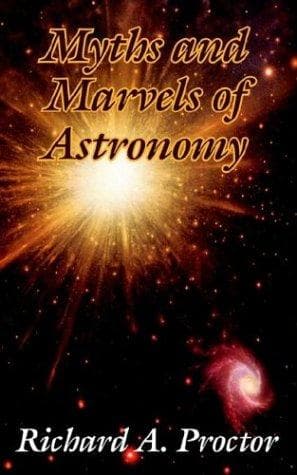
Myths and Marvels of AstronomyProctor, Richard A. (Richard Anthony)
History
Myths and Marvels of Astronomy
Proctor, Richard A. (Richard Anthony)
Astronomy
[5] To Bacon's theological contemporaries this must have seemed a
dreadful heresy, and possibly in our own days the assertion would be
judged scarcely less harshly, seeing that the observance of the
(so-called) Sabbath depends directly upon the belief in quite another
origin of the week. Yet there can be little question that the week
really had its origin in astrological formulæ.
[6] In Bohn's edition the word 'defective' is here used, entirely
changing the meaning of the sentence. Bacon registers an _Astrologia
Sana_ amongst the things needed for the advancement of learning, whereas
he is made to say that such an astrology must be registered as
defective.
[7] The astrologers were exceedingly ingenious in showing that their art
had given warning of the great plague and fire of London. Thus, the star
which marks the Bull's northern horn--and which is described by Ptolemy
as like Mars--was, they say, exactly in that part of the sign Gemini
which is the ascendant of London, in 1666. Lilly, however, for whom they
claim the credit of predicting the year of this calamity, laid no claim
himself to that achievement; nay, specially denied that he knew when the
fire was to happen. The story is rather curious. In 1651 Lilly had
published his _Monarchy or no Monarchy_, which contained a number of
curious hieroglyphics. Amongst these were two (see frontispiece) which
appeared to portend plague and fire respectively. The hieroglyphic of
the plague represents three dead bodies wrapped in death-clothes, and
for these bodies two coffins lie ready and two graves are being dug;
whence it was to be inferred that the number of deaths would exceed the
supply of coffins and graves. The hieroglyphic of the fire represents
several persons, gentlefolk on one side and commonfolk on the other,
emptying water vessels on a furious fire into which two children are
falling headlong. The occurrence of the plague in 1665 attracted no
special notice to Lilly's supposed prediction of that event, though
probably many talked of the coincidence as remarkable. But when in 1666
the great fire occurred, the House of Commons summoned Lilly to attend
the committee appointed to enquire into the cause of the fire. 'At two
of the clock on Friday, the 25th of October 1666,' he attended in the
Speaker's chamber, 'to answer such questions as should then and there be
asked him.' Sir Robert Brooke spoke to this effect: 'Mr. Lilly, this
committee thought fit to summon you to appear before them this day, to
know if you can say anything as to the cause of the late fire, or
whether there might be any design therein. You are called the rather
hither, because in a book of yours long since printed, you hinted some
such thing by one of your hieroglyphics.' Unto which he replied: 'May it
please your honours, after the beheading of the late king, considering
that in the three subsequent years the Parliament acted nothing which
concerned the settlement of the nation's peace, and seeing the
Public-domain text, read in full here on John Shaqi.
Reviews
Reviews
No reviews yet
Be the first to share your thoughts on this work.
Elsewhere in the archive
Join the Discussion
Join the discussion
Sign in to leave a comment or review.
Sign InorCreate an account