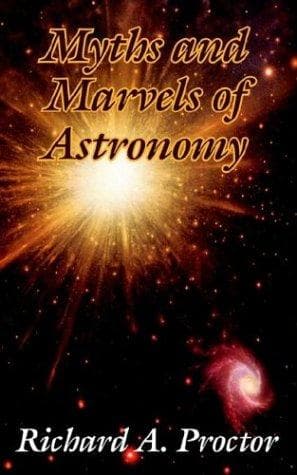
Myths and Marvels of AstronomyProctor, Richard A. (Richard Anthony)
History
Myths and Marvels of Astronomy
Proctor, Richard A. (Richard Anthony)
Astronomy
[20] It may, perhaps, occur to the reader to inquire what diameter of
the earth, supposed to be a perfect sphere, would be derived from a
degree of latitude measured with absolute accuracy near latitude 30°. A
degree of latitude measured in polar regions would indicate a diameter
greater even than the equatorial; one measured in equatorial regions
would indicate a diameter less even than the polar. Near latitude 30°
the measurement of a degree of latitude would indicate a diameter very
nearly equal to the true polar diameter of the earth. In fact, if it
could be proved that the builders of the pyramid used for their unit of
length an exact subdivision of the polar diameter, the inference would
be that, while the coincidence itself was merely accidental, their
measurement of a degree of latitude in their own country had been
singularly accurate. By an approximate calculation I find that, taking
the earth's compression at 1-300, the diameter of the earth, estimated
from the accurate measurement of a degree of latitude in the
neighbourhood of the great pyramid, would have made the sacred
cubit--taken at one 20,000,000th of the diameter--equal to 24·98 British
inches; a closer approximation than Professor Smyth's to the estimated
mean probable value of the sacred cubit.
[21] It is, however, almost impossible to mark any limits to what may be
regarded as evidence of design by a coincidence-hunter. I quote the
following from the late Professor De Morgan's _Budget of Paradoxes_.
Having mentioned that 7 occurs less frequently than any other digit in
the number expressing the ratio of circumference to diameter of a
circle, he proceeds: 'A correspondent of my friend Piazzi Smyth notices
that 3 is the number of most frequency, and that 3-1/7 is the nearest
approximation to it in simple digits. Professor Smyth, whose work on
Egypt is paradox of a very high order, backed by a great quantity of
useful labour, the results of which will be made available by those who
do not receive the paradoxes, is inclined to see confirmation for some
of his theory in these phenomena.' In passing, I may mention as the most
singular of these accidental digit relations which I have yet noticed,
that in the first 110 digits of the square root of 2, the number 7
occurs more than twice as often as either 5 or 9, which each occur eight
times, 1 and 2 occurring each nine times, and 7 occurring no less than
eighteen times.
[22] I have substituted this value in the article 'Astronomy,' of the
_British Encyclopædia_, for the estimate formerly used, viz. 95,233,055
miles. But there is good reason for believing that the actual distance
is nearly 92,000,000 miles.
Public-domain text, read in full here on John Shaqi.
Reviews
Reviews
No reviews yet
Be the first to share your thoughts on this work.
Elsewhere in the archive
Join the Discussion
Join the discussion
Sign in to leave a comment or review.
Sign InorCreate an account