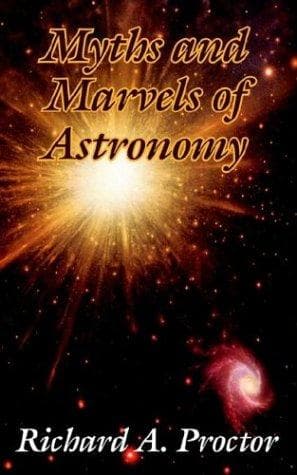
Myths and Marvels of AstronomyProctor, Richard A. (Richard Anthony)
History
Myths and Marvels of Astronomy
Proctor, Richard A. (Richard Anthony)
Astronomy
[43] Something very similar happened only a few years ago, so that we
cannot afford to laugh too freely at the terrors of France in 1773. It
was reported during the winter of 1871-1872, that Plantamour, the Swiss
astronomer, had predicted the earth's destruction by a comet on August
12, 1872. Yet there was no other foundation for this rumour than the
fact that Plantamour, in a lecture upon comets and meteors, had stated
that the meteors seen on August 10, 11, and 12 are bodies following in
the track of a comet whose orbit passes very near to the earth's. It was
very certainly known to astronomers that there could be no present
danger of a collision with this comet, for the comet has a period of at
least 150 years, and had last passed close to the earth's orbit (not to
the earth herself, be it understood) in 1862. But it was useless to
point this out. Many people insisted on believing that on August 12,
1872, the earth would come into collision, possibly disastrous, with a
mighty comet, which Plantamour was said to have detected and to have
shown by a profound calculation to be rushing directly upon our
unfortunate earth.
[44] A rather amusing mistake was made by the stenographers of a New
York paper in reporting the above sentence, which I happened to quote in
a lecture upon Comets and Meteors. Instead of Paradise they wrote Paris.
Those acquainted with Pitman's system of short-hand, the one most
commonly employed by reporters, will easily understand how the mistake
was made, the marks made to represent the consonants p, r, d, and s
differing little from those made to represent the consonants p, r, and s
(the 'd' or 't' sound is represented, or may be represented, by simply
shortening the length of the sign for the preceding consonant). The
mistake led naturally to my remarking in my next lecture that I had not
before known how thoroughly synonymous the words are in America, though
I had heard it said that 'Good Americans, when they die, go to Paris.'
[45] On the occasion of my first visit to America, in 1873, I for the
first time succeeded in obtaining a copy of this curious pamphlet. It
had been mentioned to me (by Emerson, I think) as an amusing piece of
trickery played off by a scientific man on his brethren; and Dr. Wendell
Holmes, who was present, remarked that he had a copy in his possession.
This he was good enough to lend me. Soon after, a valued friend in New
York presented me with a copy.
[46] This Locke must not be confounded with Richard Lock, the
circle-squarer and general paradoxist, who flourished a century earlier.
Public-domain text, read in full here on John Shaqi.
Reviews
Reviews
No reviews yet
Be the first to share your thoughts on this work.
Elsewhere in the archive
Join the Discussion
Join the discussion
Sign in to leave a comment or review.
Sign InorCreate an account