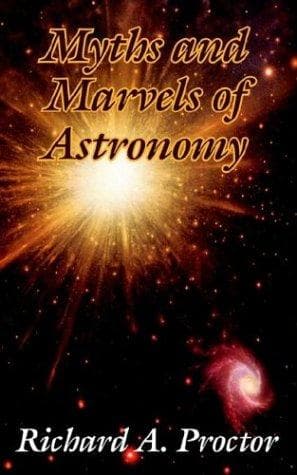
Myths and Marvels of AstronomyProctor, Richard A. (Richard Anthony)
History
Myths and Marvels of Astronomy
Proctor, Richard A. (Richard Anthony)
Astronomy
If it were permitted to men to select a sign whereby they should know
that a message came from the Supreme Being, probably the man of science
would select for the sign the communication of some scientific fact
beyond the knowledge of the day, but admitting of being readily put to
the test. The evidence thus obtained in favour of a revelation would
correspond in some sense to that depending on prophecies; but it would
be more satisfactory to men having that particular mental bent which is
called the scientific. Whether this turn of mind is inherent or the
result of training, it certainly leads men of science to be more
exacting in considering the value of evidence than any men, except
perhaps lawyers. In the case of the student of science, St. Paul's
statement that 'prophecies' 'shall fail' has been fulfilled, whereas it
may be doubted whether evidence from 'knowledge' would in like manner
'vanish away.' On the contrary, it would grow stronger and stronger, as
knowledge from observation, from experiment, and from calculation
continually increased. It can scarcely be said that this has happened
with such quasi-scientific statements as have actually been associated
with revelation. If we regard St. Paul's reference to knowledge as
relating to such statements as these, then nothing could be more
complete than the fulfilment of his own prediction, 'Whether there be
prophecies, they shall fail; whether there be tongues, they shall cease;
whether there be knowledge, it shall vanish away.' The evidence from
prophecies fails for the exact inquirer, who perceives the doubts which
exist (among the most earnest believers) as to the exact meaning of the
prophetic words, and even in some cases as to whether prophecies have
been long since fulfilled or relate to events still to come. The
evidence from 'tongues' has ceased, and those are dust who are said to
have spoken in strange tongues. The knowledge which was once thought
supernatural has utterly vanished away. But if, in the ages of faith,
some of the results of modern scientific research had been revealed, as
the laws of the solar system, the great principle of the conservation of
energy, or the wave theory of light, or if some of the questions which
still remain for men of science to solve had been answered in those
times, the evidence for the student of science would have been
irresistible. Of course he will be told that even then he would have
hardened his heart; that the inquiry after truth tending naturally to
depravity of mind, he would reject even evidence based on his beloved
laws of probability; that his 'wicked and adulterous generation seeketh
"in vain" after a sign,' and that if he will not accept Moses and the
prophets, neither would he believe though one rose from the dead. Still
the desire of the student of science to base his faith on convincing
evidence (in a matter as important to him as to those who abuse him)
does seem to have something reasonable in it after all. The mental
Public-domain text, read in full here on John Shaqi.
Reviews
Reviews
No reviews yet
Be the first to share your thoughts on this work.
Elsewhere in the archive
Join the Discussion
Join the discussion
Sign in to leave a comment or review.
Sign InorCreate an account