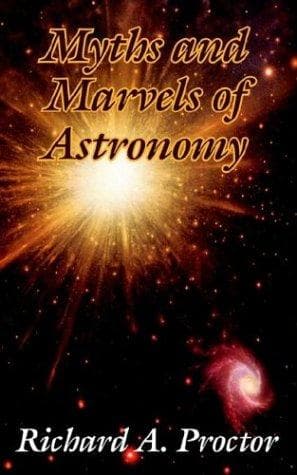
Myths and Marvels of AstronomyProctor, Richard A. (Richard Anthony)
History
Myths and Marvels of Astronomy
Proctor, Richard A. (Richard Anthony)
Astronomy
For instance, Swedenborg's description of the inhabitants of Mercury and
their love of abstract knowledge contains an instructive lesson. 'The
spirits of Mercury imagine,' he says, 'that they know so much, that it
is almost impossible to know more. But it has been told them by the
spirits of our earth, that they do not know many things, but few, and
that the things which they know not are comparatively infinite, and in
relation to those they do know are as the waters of the largest ocean to
those of the smallest fountain; and further, that the first advance to
wisdom is to know, acknowledge, and perceive that what we do know,
compared with what we do not know, is so little as hardly to amount to
anything.'[27] So far we may suppose that Swedenborg presents his own
ideas, seeing that he is describing what has been told the Mercurial
spirits by the spirits of our earth, of whom (during these spiritual
conversations) he was one. But he proceeds to describe how angels were
allowed to converse with the Mercurial spirits in order to convince them
of their error. 'I saw another angel,' says he, after describing one
such conversation, 'conversing with them; he appeared at some altitude
to the right; he was from our earth, and he enumerated very many things
of which they were ignorant.... As they had been proud on account of
their knowledges, on hearing this they began to humble themselves. Their
humiliation was represented by the sinking of the company which they
formed, for that company then appeared as a volume or roll, ... as if
hollowed in the middle and raised at the sides.... They were told what
that signified, that is, what they thought in their humiliation, and
that those who appeared elevated at the sides were not as yet in any
humiliation. Then I saw that the volume was separated, and that those
who were not in humiliation were remanded back towards their earth, the
rest remaining.'
Public-domain text, read in full here on John Shaqi.
Reviews
Reviews
No reviews yet
Be the first to share your thoughts on this work.
Elsewhere in the archive
Join the Discussion
Join the discussion
Sign in to leave a comment or review.
Sign InorCreate an account