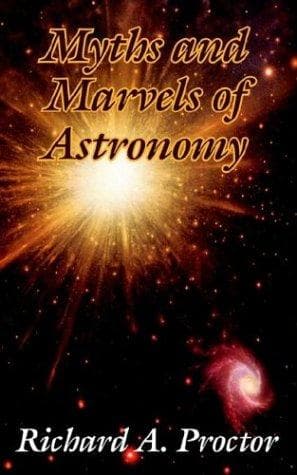
Myths and Marvels of AstronomyProctor, Richard A. (Richard Anthony)
History
Myths and Marvels of Astronomy
Proctor, Richard A. (Richard Anthony)
Astronomy
The shadow thus thrown upon the planet
creeps slowly, first one way, then another, northwards and southwards
over the illuminated hemisphere of the planet (as pictured in the 13th
plate of my treatise on Saturn), requiring for its passage from the
arctic to the antarctic regions and back again to the arctic regions of
the planet, a period nearly equal to that of a generation of terrestrial
men. Nearly thirty of our years the process lasts, during half of which
time the northern hemisphere suffers, and during the other half the
southern. The shadow band, which be it remembered stretches right
athwart the planet from the extreme eastern to the extreme western side
of the illuminated hemisphere, is so broad during the greater part of
the time that in some regions (those corresponding to our temperate
zones) the shadow takes two years in passing, during which time the sun
cannot be seen at all, unless for a few moments through some chinks in
the rings, which are known to be not solid bodies, but made up of
closely crowded small moons. And the slow passage of this fearful
shadow, which advances at the average rate of some twenty miles a day,
but yet hangs for years over the regions athwart which it sweeps, occurs
in the very season when the sun's small direct supply of heat would
require to be most freely compensated by nocturnal light--in the winter
season, namely, of the planet. Moreover, not only during the time of the
shadow's passage, but during the entire winter half of the Saturnian
year, the ring reflects no light during the night time, the sun being on
the other or summer side of the ring's plane.[30] The only nocturnal
effect which would be observable would be the obliteration of the stars
covered by the ring system. It is strange that, this being so, the
spirits from Saturn should have made no mention of the circumstance;
and even more strange that these spirits and others should have asserted
that the moons and rings of Saturn compensate for the small amount of
light directly received from the sun. Most certainly a Swedenborg of our
own time would find the spirits from Saturn more veracious and more
communicative about these matters, though even what _he_ would hear from
the spirits would doubtless appear to sceptics of the twenty-first
century to be no more than he could have inferred from the known facts
of the science of his day.
Public-domain text, read in full here on John Shaqi.
Reviews
Reviews
No reviews yet
Be the first to share your thoughts on this work.
Elsewhere in the archive
Join the Discussion
Join the discussion
Sign in to leave a comment or review.
Sign InorCreate an account