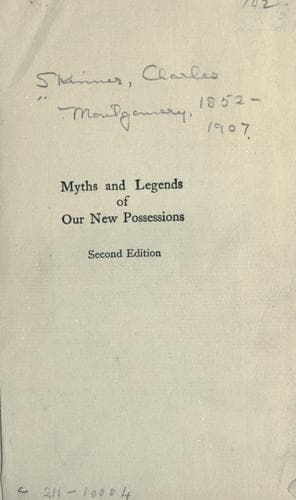
Myths & Legends of our New Possessions & ProtectorateSkinner, Charles M. (Charles Montgomery)
History
Myths & Legends of our New Possessions & Protectorate
Skinner, Charles M. (Charles Montgomery)
Tales -- Oceania; Tales -- West Indies
With the cession of this largest of the Ladrone islands we fall heir to
some race problems as baffling as those presented by our Indians. The
natives of this group belong to the Tarapons, and the traditions
of these people say that they came in part from the east and partly
from the west. It has been thought that they have a slight mixture of
Mongolian blood, and this is not unlikely, for Chinese and Japanese
junks have at various times been blown over sea to farther shores than
these. History for this group begins with Magellan, who named it for
the ladrones or thieves, who annexed his belongings when he arrived
on the first voyage that had ever been made around the world. That
they had crafts and arts is proved by their weapons, canoes, cloth,
and armor, and they have left here some remarkable stone columns,
more than twice the height of a man, with hemispheres of rock on their
tops, flat sides uppermost, and six feet wide. In Tinian, Kusaie,
and also in Ponape, in the Carolines, there are ruins, including,
in the latter island, a court three hundred feet long with walls ten
yards high, some of the monoliths being twenty-five feet long and
eight feet thick. On Tongataboo are larger rocks, forty feet high,
which were quarried elsewhere and shipped to that coral island. On
Easter Island are platforms a hundred yards long, ten wide and ten
high, with great statues all cut from stone. None of these remains,
nor the picture-writing found near the statues, throw light on the
history, purpose, or personality of their builders. Every family has
its little circle of shells and stones which is a shrine where the
gods are worshipped, and most of the gods are spirits of the great
and wise who died long ago. Offerings to these took the form of food
and of anointing for their altars, but human sacrifices were no doubt
demanded at times, when the priests had been specially venturesome
in asking favors. When a man died his soul sprang out, went below
the earth, and found felicity in the west. This belief resembles
the Indian faith in the happy hunting-ground, and incidentally it
points the course of empire. The spirit could return once in a while,
and ghostly visitations were sorely dreaded. The institution of the
taboo was and is connected with the native religions of the Pacific
islands. We have adopted the word and use it in its true meaning
of forbidden. If an article were dedicated to a god, or used in his
worship, or had been touched by him, or claimed by a chief or a priest,
no commoner dared lay finger on it, for it was as sacred as the ark of
the covenant. Some canny planters kept boys out of their orchards and
palm groves by offering the fruit to certain gods until it was ripe,
for a sign of taboo kept out all marauders till the crop was ready for
gathering, when the owner changed his mind and claimed it himself. To
break a taboo was not only to incur the wrath of the priests, but of
Public-domain text, read in full here on John Shaqi.
Reviews
Reviews
No reviews yet
Be the first to share your thoughts on this work.
Elsewhere in the archive
Join the Discussion
Join the discussion
Sign in to leave a comment or review.
Sign InorCreate an account