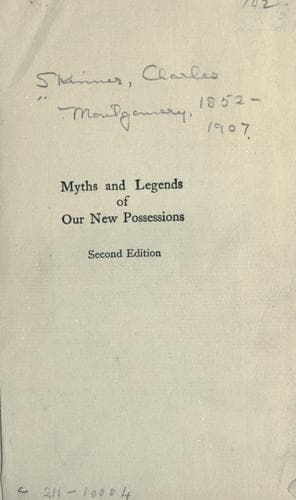
Myths & Legends of our New Possessions & ProtectorateSkinner, Charles M. (Charles Montgomery)
History
Myths & Legends of our New Possessions & Protectorate
Skinner, Charles M. (Charles Montgomery)
Tales -- Oceania; Tales -- West Indies
arose the cloud was gone; the ships had sailed away. He was alone.
The commander of the ships was Magellan. It was one of his monks who
had placed the cross on shore. Landing in Cebu later, he converted two
thousand of the natives in a day by destroying the statue of Vishnu and
putting that of the child Jesus in its place, though he still yielded
to savage opinion in so far as he consented to confirm his friendship
with the king by a heathen ceremony, each opening a vein in his arm
and drinking the blood of the other. As usual, the appearance and ways
of the Europeans smote the natives with wonder. They described the
strangers as enormous men with long noses, who dressed in fine robes,
ate stones (ship-bread), drank fire from sticks (pipes), and breathed
out the smoke, commanded thunder and lightning from metal tubes,
and were gods. Engaging in a wrangle between two tribes, Magellan was
lured into a marsh at Mactan, and there, while watching a battle to
see how great the Filipinos could be in war, he was slain with bamboo
lances sharpened and hardened in fire. Amambar's Christianity did
not endure, for he so wearied of the oppression and rapacity of the
strangers that when a successor to Magellan appeared he invited him
to a banquet and slew him at his meat. But the cross and the statue
of Christ worked miracles among the faithful for many generations.
The Bedevilled Galleon
"Sing hey, sing ho! The wind doth blow,
And I'll meet my love in the morning,"
Sang the lookout, as he paced the forecastle of the galleon Rose of
May, and peered about for signs of land against the dawn. Not that
he expected to meet his love in the morning, nor for many mornings,
but he had been up in his off-watch and was getting drowsy, so that he
sang to keep himself awake. His was one of the first among the English
ships to follow in Magellan's track. The Philippines, or the Manillas,
as they were called, had been almost reached, and it was expected
that Mindanao would be sighted at break of day off the starboard bow.
"Hello, forward!" bawled the man at the helm.
"Ay, ay!" sang the lookout.
"What d'ye make o' yonder light?"
"Light? What d'ye mean, man?" And the lookout rubbed his eyes, scanned
the water close and far, and wondered if his sight was going out.
"In the sky, o' course, ye bumble-brain."
"Now, by the mass, you costard, you gave me a twist of the inwards
with your lame joke."
"'Tis no joke. Will you answer?"
"Why, then, 'tis the daylight, in course, and you aiming for it that
steady as to drive the nose of us straight agin the sun, give he
comes up where he threats to. And he'll be here straightway, for in
these waters he comes up as he were popped outen a cohorn."
"The day! Heaven forefend! I'm holding her to the north."
"You're holding due east. Aha! Look yonder, where the cloud is
lifting. Land ho!"
"Where away?" cried a mate, roused out of a forbidden doze by this
talk, and blundering up to the roof of the after-castle.
Public-domain text, read in full here on John Shaqi.
Reviews
Reviews
No reviews yet
Be the first to share your thoughts on this work.
Elsewhere in the archive
Join the Discussion
Join the discussion
Sign in to leave a comment or review.
Sign InorCreate an account