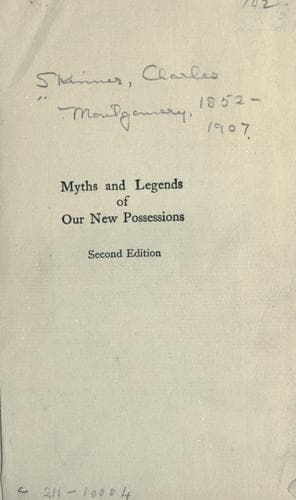
Myths & Legends of our New Possessions & ProtectorateSkinner, Charles M. (Charles Montgomery)
History
Myths & Legends of our New Possessions & Protectorate
Skinner, Charles M. (Charles Montgomery)
Tales -- Oceania; Tales -- West Indies
There was the mischief,--in those jars and bottles. Nobody would put
a serpent or a scorpion into alcohol except for some grim purpose,
and that purpose could be nothing other than black magic. Hence the
raid on the inn; hence the killing of the naturalists and of other
people suspected of complicity or sympathy with forbidden arts;
hence the state of education of Luzon.
Faith that Killed
Back in the 30's an emigrant of some account arrived in Manila. He was
a young doctor of medicine who had just won his sheepskin in Salamanca,
and had been persuaded that there was small hope of a living for
him in a province where the people were too poor to be ill and too
lazy to die. The Philippines had been suggested as a promising field
for his practice, and realizing that he needed practice he made the
long journey around Good Hope and reached the Luzon capital nearly
penniless, but full of gratitude and expectancy. Having secured
lodgings, to which he at once affixed his shingle, he sallied forth to
see the town and its people, and one of the first of its inhabitants
to claim his attention, though she claimed it unwittingly, was a
girl of the lower class who was walking along the street with an
easy, elastic step, and in seeming health, yet who was evidently
suffering from a hemorrhage, for at every few paces she paused and
spat blood. Her bearing and expression were in odd contrast with her
peril, for she seemed indifferent to the danger.
Prompted by compassion as well as by a professional interest,
the physician followed the invalid, expecting at every moment to
see her fall or hear her beg for help, his wonder at the stoicism
and endurance of the Filipino growing constantly. When she reached
her home, an humble house in a poor quarter of the city, he begged
immediate audience with her parents, who were, unfortunately,
acquainted with the Spanish tongue, and told them it was his duty to
warn them that the girl had not twenty-four hours to live; that she
was afflicted with a mortal illness; that a priest should be called
at once. The girl's cheeks were ruddy, she was in good spirits, and
the old people were inclined to resent the warning as a joke, being an
exceeding poor one. The visitor explained that he was a medical man,
that he was actuated by the most charitable of motives, that he would
do everything in his power to delay the fatal ending of the disease,
but that restoration to health was impossible.
Public-domain text, read in full here on John Shaqi.
Reviews
Reviews
No reviews yet
Be the first to share your thoughts on this work.
Elsewhere in the archive
Join the Discussion
Join the discussion
Sign in to leave a comment or review.
Sign InorCreate an account