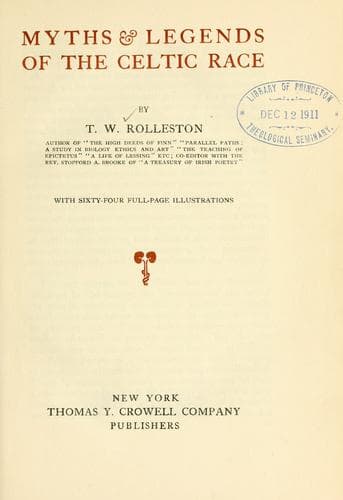
Myths & Legends of the Celtic RaceRolleston, T. W. (Thomas William)
Religion
Myths & Legends of the Celtic Race
Rolleston, T. W. (Thomas William)
Celts -- Religion; Mythology, Celtic
When the armies met, Cuchulain and the two sons of Skatha wrought great
deeds on the foe, and slew six of the mightiest of Aifa’s warriors. Then
Aifa sent word to Skatha and challenged her to single combat. But
Cuchulain declared that he would meet the fair Fury in place of Skatha,
and he asked first of all what were the things she most valued. “What Aifa
loves most,” said Skatha, “are her two horses, her chariot and her
charioteer.” Then the pair met in single combat, and every champion’s feat
which they knew they tried on each other in vain, till at last a blow of
Aifa’s shattered the sword of Cuchulain to the hilt. At this Cuchulain
cried out: “Ah me! behold the chariot and horses of Aifa, fallen into the
glen!” Aifa glanced round, and Cuchulain, rushing in, seized her round the
waist and slung her over his shoulder and bore her back to the camp of
Skatha. There he flung her on the ground and put his knife to her throat.
She begged for her life, and Cuchulain granted it on condition that she
made a lasting peace with Skatha, and gave hostages for her fulfilment of
the pledge. To this she agreed, and Cuchulain and she became not only
friends but lovers.
*The Tragedy of Cuchulain and Connla*
Before Cuchulain left the Land of Shadows he gave Aifa a golden ring,
saying that if she should bear him a son he was to be sent to seek his
father in Erin so soon as he should have grown so that his finger would
fit the ring. And Cuchulain said, “Charge him under _geise_ that he shall
not make himself known, that he never turn out of the way for any man, nor
ever refuse a combat. And be his name called Connla.”
In later years it is narrated that one day when King Conor of Ulster and
the lords of Ulster were at a festal gathering on the Strand of the
Footprints they saw coming towards them across the sea a little boat of
bronze, and in it a young lad with gilded oars in his hands. In the boat
was a heap of stones, and ever and anon the lad would put one of these
stones into a sling and cast it at a flying sea-bird in such fashion that
it would bring down the bird alive to his feet. And many other wonderful
feats of skill he did. Then Conor said, as the boat drew nearer: “If the
grown men of that lad’s country came here they would surely grind us to
powder. Woe to the land into which that boy shall come!”
When the boy came to land, a messenger, Condery, was sent to bid him be
off. “I will not turn back for thee,” said the lad, and Condery repeated
what he had said to the king. Then Conall of the Victories was sent
against him, but the lad slung a great stone at him, and the whizz and
wind of it knocked him down, and the lad sprang upon him, and bound his
arms with the strap of his shield. And so man after man was served; some
were bound, and some were slain, but the lad defied the whole power of
Ulster to turn him back, nor would he tell his name or lineage.
Public-domain text, read in full here on John Shaqi.
Reviews
Reviews
No reviews yet
Be the first to share your thoughts on this work.
Elsewhere in the archive
Join the Discussion
Join the discussion
Sign in to leave a comment or review.
Sign InorCreate an account